Malaysia Import Tax 2026: Duties, SST & Customs Explained
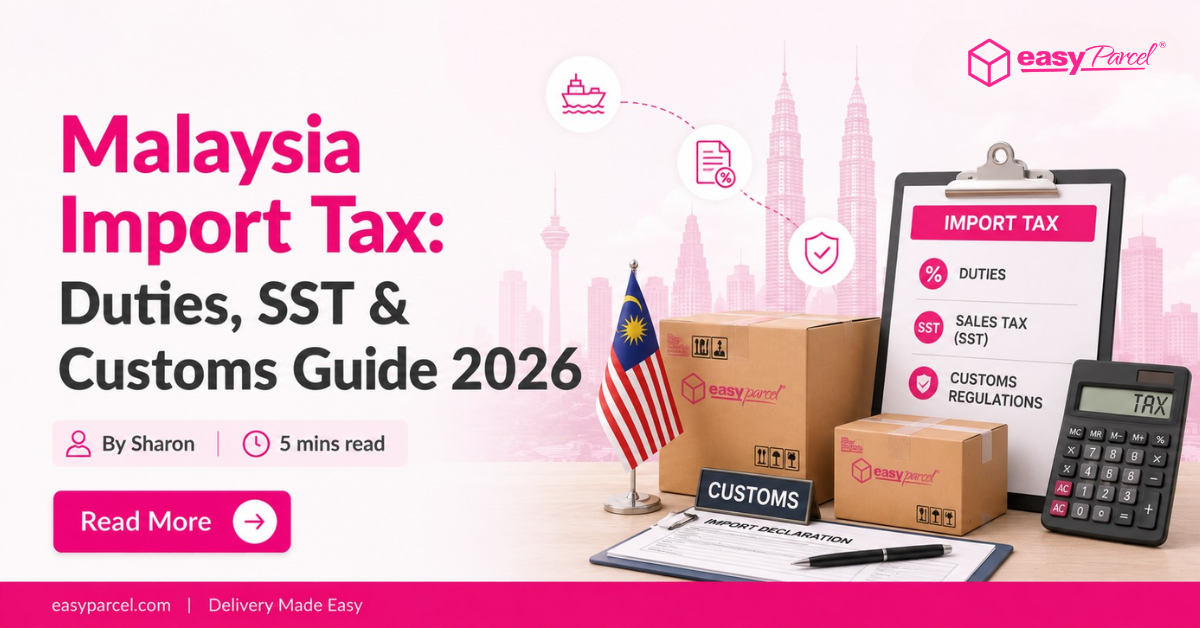
Planning to buy something overseas or import products into Malaysia? Before your shipment arrives, it’s important to understand Malaysia import tax and the additional costs that may apply.
Depending on what you’re importing, your shipment may be subject to import duty, sales tax, excise duty or other customs requirements. The amount isn’t the same for every parcel—it depends on factors such as the product classification, value and applicable exemptions.
Malaysia also has specific rules for Low Value Goods (LVG) and eligible shipments valued at RM500 or below, which can sometimes cause confusion for online shoppers and importers.
Here’s what you should know about Malaysia import tax in 2026.
What Is Malaysia Import Tax?
Malaysia import tax generally refers to duties and taxes that may be imposed when goods enter Malaysia from another country.
Depending on the product, applicable charges may include:
- Import duty
- Sales tax on imported goods
- Excise duty for certain goods
- Other applicable customs charges
Sales tax applies to taxable goods manufactured in Malaysia as well as taxable goods imported into Malaysia.
However, not every imported product is taxed at the same rate.
Your product’s HS or tariff code is particularly important because it helps Customs determine the correct classification and applicable tax treatment.
How Much Is Import Tax in Malaysia?
There is no single Malaysia import tax rate that applies to every imported product.
As of August 2026, Malaysia’s current sales tax framework generally imposes 10% sales tax on taxable goods unless the goods fall under an applicable exemption or another prescribed rate. Selected goods are subject to 5% or specific rates, while exempt goods are covered under separate exemption orders.
A simple overview is:
| Tax Treatment | Current Rate / Treatment |
|---|---|
| General taxable goods | 10% unless otherwise specified |
| Selected taxable goods | 5% |
| Certain goods | Specific rates |
| Exempt goods | Exempt, subject to applicable rules |
| Qualifying Low Value Goods | 10% LVG sales tax |
The sales tax structure took effect from 1 July 2025, with subsequent amendments to the relevant orders.
Because the rate depends on the product’s classification, you should not assume every import into Malaysia is automatically taxed at 10%.
What Determines Your Malaysia Import Tax?
Several factors can affect how much you ultimately pay.
1. Type of Goods
Different products have different customs classifications and tax treatments.
2. HS Code
The Harmonized System (HS) Code identifies the type of product being imported and helps determine the applicable duty and tax treatment.
3. Customs Value
The value Customs uses to assess your shipment can affect the amount of tax or duty payable.
4. Country of Origin
Some goods may qualify for preferential tariff treatment under applicable trade agreements, subject to the relevant rules and documentation.
5. Applicable Exemptions
Certain products or shipments may qualify for customs or sales tax exemptions.
What Is the RM500 De Minimis Rule?
If you’ve searched for Malaysia import tax, you may have seen people saying:
“Anything below RM500 is tax-free.”
That’s an oversimplification.
Malaysia does have a de minimis facility for qualifying shipments imported by air courier services, including postal services.
Under this facility, goods with a total CIF value not exceeding RM500 per consignment may qualify for exemption from applicable import duty and sales tax on imports, subject to the relevant conditions and exclusions.
CIF means:
Cost + Insurance + Freight
Royal Malaysian Customs’ current ePAM information also identifies goods not exceeding RM500 CIF per consignment as potentially eligible for immediate clearance and duty/tax exemption, subject to its requirements.
Certain products are excluded from the de minimis treatment, so the RM500 threshold should never be interpreted as a universal tax exemption.
What Is Malaysia Low Value Goods (LVG) Tax?
This is where many shoppers get confused.
Malaysia’s Low Value Goods (LVG) framework is separate from the de minimis facility.
LVG generally refers to qualifying goods from overseas that are:
- Sold online;
- Sold at a price of RM500 or below; and
- Delivered to consumers in Malaysia by land, sea or air.
Malaysia imposes a 10% sales tax on qualifying LVG under this framework.
So, for example, if a qualifying LVG item is sold for:
RM300
The LVG sales tax would generally be:
RM300 × 10% = RM30
The important point is that LVG sales tax and the de minimis import facility are not the same thing.
RM500 De Minimis vs Low Value Goods: What's the Difference?
Here’s an easier way to understand the two:
| RM500 De Minimis | Low Value Goods (LVG) | |
|---|---|---|
| Threshold | CIF not exceeding RM500 | Sale price not exceeding RM500 |
| Relevant To | Import-stage duty/tax exemption | Sales tax on qualifying online purchases |
| Shipping Method | Qualifying air courier/postal shipments | Land, sea or air |
| Tax Treatment | May qualify for import duty/tax exemption | 10% LVG sales tax |
| Are all goods eligible? | No | No |
Malaysia’s official LVG guidance specifically recognises the existing de minimis facility alongside the LVG framework.
Therefore, “under RM500 = completely tax-free” is not a reliable rule to follow in 2026.
Plan Your International Shipping Costs with EasyParcel
Use EasyParcel to compare international courier services, identify HS Codes and estimate potential duties and taxes before sending your parcel.

What Is an HS Code?
An HS Code, or Harmonized System Code, is an internationally recognised classification system used to identify goods traded across borders.
Your HS Code helps Customs determine:
- What you’re importing
- Whether import duty applies
- Applicable sales tax treatment
- Whether the product is exempt
- Whether permits or approvals may be required
Royal Malaysian Customs advises users to confirm the tariff code and then refer to the relevant Sales Tax Rate Order and exemption order to determine the applicable sales tax treatment.
This is why using the correct HS Code is important when preparing an international shipment.
How EasyParcel Can Help with International Shipping
Smart HS Code
Not sure which HS Code to use? Smart HS Code can help suggest a suitable code based on your product information.
Duties & Taxes Calculator
Estimate potential import duties and taxes before shipping to get better visibility of possible cross-border costs.

Compare International Courier Services
Compare available international courier services based on shipping rates and estimated delivery times before booking.

Doorstep Pickup or Drop-Off
Depending on the selected courier service, choose between convenient doorstep pickup or an available drop-off option.

EasyTrack
Monitor your international shipment from pickup through successful delivery.
These tools can help you prepare for international shipping, but the final customs classification, duties, taxes and clearance decisions remain subject to the relevant customs authority.
Malaysia Import Tax 2026: Quick Summary
Here’s what you should remember:
| Question | Quick Answer |
|---|---|
| Is there one Malaysia import tax rate? | No |
| General sales tax rate? | 10% unless otherwise specified |
| Other sales tax rates? | 5% or specific rates for selected goods |
| LVG threshold? | RM500 or below |
| LVG sales tax? | 10% |
| De minimis threshold? | CIF not exceeding RM500 for qualifying shipments |
| Are all parcels below RM500 tax-free? | No |
| Does HS Code matter? | Yes |
The MySST portal continues to state that sales tax rates can be 5%, 10% or a specific rate, while the 2025 framework sets 10% as the general rate for taxable goods unless otherwise specified.
Last updated: August 2026
Final Thoughts
Understanding Malaysia import tax can help you make better decisions when buying products overseas or importing goods for your business.
As of August 2026, Malaysia generally imposes 10% sales tax on taxable goods unless otherwise specified, while selected goods may be taxed at 5% or specific rates, and other goods may qualify for exemptions.
For lower-value shipments, remember that Malaysia’s RM500 de minimis facility and 10% Low Value Goods sales tax are separate concepts. A parcel being worth less than RM500 does not automatically mean that no tax applies.
Malaysia’s tax rules can also change. Royal Malaysian Customs published further sales-tax-related updates during 2026, while the MySST expansion page was last updated on 19 July 2026. For this reason, always verify your product’s latest HS Code, applicable tax rate and exemption status with the Royal Malaysian Customs Department before importing.