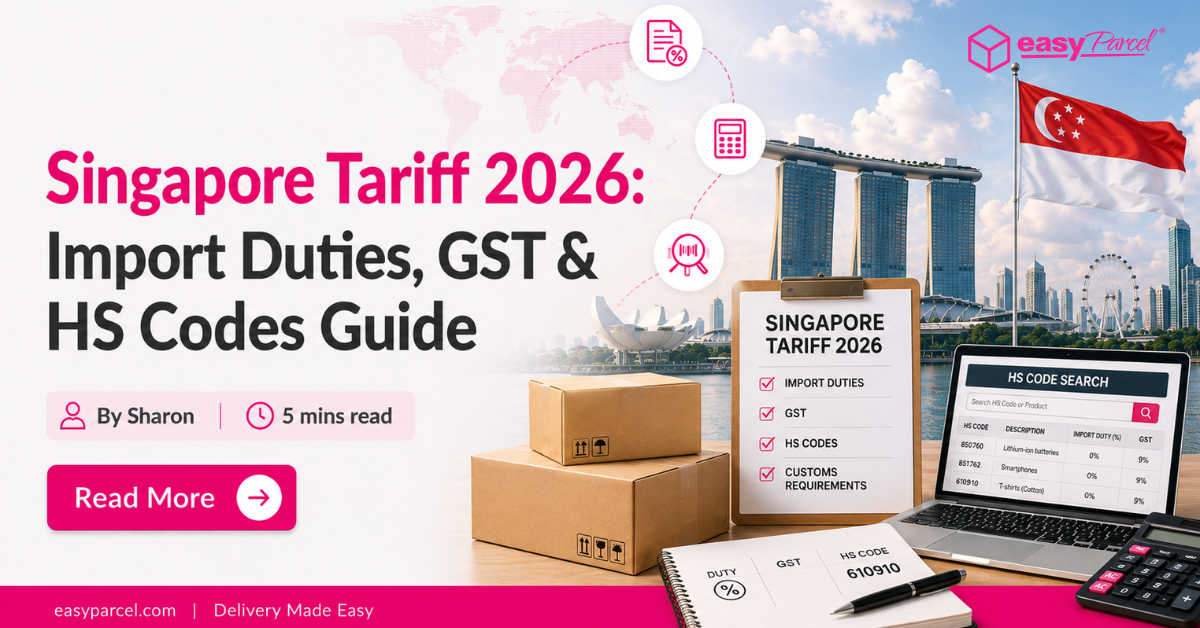
Importing goods into Singapore? Understanding the Singapore tariff system can help you estimate costs, classify your products correctly and prepare for customs clearance.
Singapore is generally known for having relatively few dutiable imports. However, this doesn’t mean every import enters Singapore without charges. Depending on the goods, you may still need to consider customs or excise duty, GST and other import requirements.
Here’s a simple guide to how Singapore tariffs work in 2026.
Table of Contents
What Is a Singapore Tariff?
A tariff is generally a duty imposed on certain goods when they are imported.
In Singapore, goods are classified using Harmonised System (HS) Codes. Singapore uses 8-digit HS codes for customs declarations, while the international HS system is harmonised at the first six digits.
Your product classification helps determine:
- Whether customs duty applies
- The applicable duty rate
- Whether the product is controlled
- Whether permits or approvals are required
- How the goods should be declared
Importantly, customs duty and GST are not the same thing.
Are All Imports Subject to Singapore Tariffs?
No.
Singapore imposes duties only on certain categories of dutiable goods. These primarily include:
| Dutiable Category | Examples |
|---|---|
| Intoxicating liquors | Beer, wine and spirits |
| Tobacco products | Cigarettes and other tobacco products |
| Motor vehicles | Cars and certain other vehicles |
| Petroleum products & biodiesel blends | Certain fuel and petroleum products |
The exact duty depends on the product’s classification and applicable rate.
Singapore Customs also made tariff revisions in 2026. For example, excise duties on cigarettes and other manufactured tobacco products were increased from 12 February 2026.
For this reason, always check the latest tariff rate rather than relying on an old article or rate table.
Singapore Tariff vs GST: What's the Difference?
This is one of the most important distinctions.
Customs Duty
Only applies to specified dutiable goods.
GST
Can apply to imported goods even when they aren’t subject to customs duty.
For imported non-dutiable goods, GST is generally calculated based on the CIF value plus applicable incidental charges. For dutiable goods, the taxable amount also includes the customs or excise duty payable.
CIF means:
Cost + Insurance + Freight
So a product having 0% customs duty does not automatically mean there are no import taxes or charges to consider.
What Is an HS Code?
The Harmonised System (HS) Code is an internationally recognised system for classifying traded products.
For Singapore customs declarations, the correct 8-digit HS Code should be declared based on the goods description.
For example, HS classification progresses from broad categories to more specific products:
Chapter → Heading → Subheading → Singapore Tariff Classification
The first six digits are internationally harmonised, while Singapore uses additional digits for its local tariff classification.
Why Is the Correct HS Code Important?
Using the correct HS Code helps determine whether:
- Your product is dutiable
- A particular tariff rate applies
- Your product is controlled
- Additional documentation is required
Singapore Customs provides an HS/CA Product Code Search that can be used to find HS Codes and check whether products are controlled.
Incorrect classification can potentially lead to inaccurate customs declarations, so don’t simply guess an HS Code based on a similar product.
How Is Singapore Import Tax Calculated?
The calculation depends on whether your product is dutiable.
For a non-dutiable product, the taxable value generally starts from:
Cost + Insurance + Freight + Applicable Incidental Charges
For dutiable goods, GST is generally computed after including applicable customs or excise duty in the taxable value.
Because the calculation and duty rate depend on the individual product, always check the latest Singapore Customs requirements for your specific shipment.
Does Singapore Have Free Trade Agreements?
Yes. Singapore has an extensive network of Free Trade Agreements (FTAs).
Depending on the product, its country of origin and the relevant agreement, qualifying goods may receive preferential tariff treatment.
However, simply shipping goods from an FTA partner doesn’t automatically qualify them for preferential treatment. The goods generally need to satisfy the applicable Rules of Origin and documentation requirements.
How to Check Singapore Tariffs Before Importing
Before shipping goods into Singapore:
1. Identify Your Product
Prepare a clear and accurate description of what you’re importing.
2. Find the Correct HS Code
Use Singapore Customs’ HS/CA Product Code Search to determine the appropriate classification.
3. Check Whether It Is Dutiable
Confirm whether customs or excise duty applies to your product.
4. Check GST
Remember that non-dutiable goods can still be subject to GST.
5. Check Import Restrictions
Determine whether your product is controlled, restricted or requires additional permits.
Shipping Internationally? EasyParcel Can Help
Understanding the Singapore tariff is only one part of international shipping.
EasyParcel provides useful tools to make cross-border shipping preparation simpler:
Smart HS Code
Get suggested HS Codes based on your product information to help prepare customs declarations.
Duties & Taxes Calculator
Estimate potential import duties and taxes before shipping to get better visibility of your potential costs.

Compare International Couriers
Compare available international courier services based on shipping rates and estimated delivery times.

EasyTrack
Monitor your international shipments from pickup through successful delivery.
Singapore Tariff 2026: Quick Summary
| Question | Quick Answer |
|---|---|
| Does Singapore have import tariffs? | Yes, for specified dutiable goods |
| Are all imports dutiable? | No |
| Can GST still apply? | Yes |
| Does Singapore use HS Codes? | Yes, 8-digit codes for customs declarations |
| Can FTAs reduce tariffs? | Potentially, if applicable requirements are met |
| Where should rates be verified? | Singapore Customs |
Final Thought
Understanding the Singapore tariff system doesn’t have to be complicated. The key thing to remember is that customs duty and GST are different. Many imported products may not attract customs duty, but GST and other customs requirements can still apply.
Your product’s HS Code is also essential for determining its correct customs treatment. Singapore Customs specifically requires traders and declaring agents to declare the correct 8-digit HS Code based on the goods description.
Before importing, check the latest classification, tariff and customs requirements with Singapore Customs, especially because tariff rates can change—as demonstrated by the duty revisions introduced in February 2026.