Singapore
 Thailand
 Indonesia
For cross-border sellers shipping into Malaysia, the postcode is a small field with a big operational impact. Malaysia uses a five-digit numeric postcode, and the address should place that code together with the town or city to support smoother sorting, routing, and delivery.
If your store, marketplace listing, or checkout form refers to a “Malaysia ZIP code,” treat it as the same customer input in practice, but label and validate it as a postcode for cleaner local handling.
Contents
What Is the Malaysia Postcode Format?
Source: Postal Code
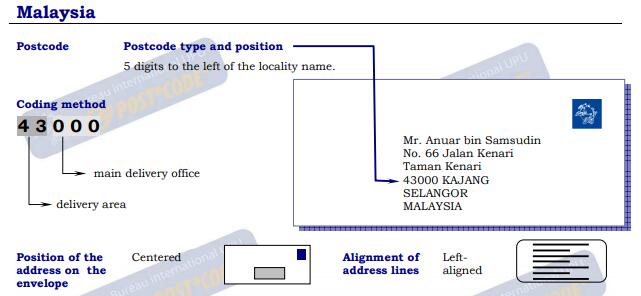
The Malaysia postcode format is five digits, with no letters, spaces, or hyphens. In Universal Postal Union notation, Malaysia’s postcode format is listed as 99999, meaning five numeric characters, and example Malaysian address structures show the postcode directly before the town name, such as 56000 KUALA LUMPUR.
That simple format is helpful for ecommerce teams because it is easy to validate at checkout. A customer may type a code with extra spaces, or a team member may paste an address from a chat message, but your system should ultimately store the postcode as five digits only. For sellers serving Indonesian-speaking buyers or internal teams, the search phrase kode pos malaysia usually refers to this same five-digit Malaysian postcode.
It is also worth clarifying the terminology. “Postcode” and “postal code” are the safer terms for Malaysia, while “zip code” is commonly understood because many shoppers have seen it on international websites. When your form says malaysia postal code, most customers will know what to enter; when it says malaysia zip code, some customers may still understand it, but the wording is less locally precise.
State-by-State: What Malaysian Postcodes Look Like
Malaysia postcodes are always five digits, and the first two digits usually indicate the state or federal territory. Below is a practical reference to what each state’s postcodes typically look like (as prefixes), which is useful for quick sanity checks in checkout, customer support, and fulfillment.
State / Federal Territory Common postcode prefixes (first 2 digits) Looks like
| Perlis | 01–02 | 01xxx–02xxx |
| Kedah | 05–09 | 05xxx–09xxx |
| Penang (Pulau Pinang) | 10–14 | 10xxx–14xxx |
| Kelantan | 15–18 | 15xxx–18xxx |
| Terengganu | 20–24 | 20xxx–24xxx |
| Pahang | 25–28, 39 | 25xxx–28xxx, 39xxx |
| Perak | 30–36 | 30xxx–36xxx |
| Selangor | 40–48, 63–68 | 40xxx–48xxx, 63xxx–68xxx |
| Federal Territory of Kuala Lumpur | 50–60 | 50xxx–60xxx |
| Federal Territory of Putrajaya | 62 | 62xxx |
| Negeri Sembilan | 70–73 | 70xxx–73xxx |
| Melaka | 75–78 | 75xxx–78xxx |
| Johor | 79–86 | 79xxx–86xxx |
| Federal Territory of Labuan | 87 | 87xxx |
| Sabah | 88–91 | 88xxx–91xxx |
| Sarawak | 93–98 | 93xxx–98xxx |
Tip: Treat this as a validation aid, not proof. A five-digit code can still be “valid” in format but wrong for the customer’s exact locality.
Why Postcode Accuracy Matters for Cross-Border Delivery

Source: Pinterest
A postcode helps connect the parcel to the right delivery area, sorting route, and last-mile process. The UPU describes the postcode as an essential address element that identifies the addressee’s locality and supports manual or automated sorting. For sellers, that means an incorrect or missing code can create practical problems long before the parcel reaches the customer’s door.
When an order comes from overseas, the address is often touched by multiple systems: your ecommerce platform, payment or fraud tools, warehouse software, label-generation tools, customs documentation, airline or line-haul partners, and a local delivery network. A weak postcode field may pass through one system but fail in another. That can lead to manual review, delayed dispatch, carrier re-labeling, failed delivery attempts, or customer support tickets.
Postcode accuracy also affects buyer confidence. A shopper who has entered a detailed address expects your store to preserve it correctly. If the label prints with the wrong town, a missing digit, or a code that does not match the customer’s locality, the delivery may still eventually arrive, but the customer experience becomes uncertain. For repeat buyers, that uncertainty can be more damaging than the shipping cost itself.
The Practical Address Structure Sellers Should Capture
A Malaysian delivery address may be short and simple, or it may include building names, unit numbers, residential areas, villages, industrial parks, P.O. Boxes, or locked bags. UPU examples for Malaysia show several valid patterns, including street addresses, company names, P.O. Box addresses, and addresses where the postcode appears before the town or city. The safest ecommerce approach is to capture enough structured data while still allowing customers to enter local address details naturally.
A practical checkout structure can include:
- Recipient name: Capture the full individual or company name. For business deliveries, allow a company name field so warehouse teams do not squeeze it into the street address.
- Phone number: This is useful for delivery coordination, especially when a building has security, a gated entrance, or an office reception process.
- Address line 1: Use this for unit number, house number, building, street, road, or lot information.
- Address line 2: Use this for taman, kampung, apartment name, industrial area, floor, block, or other local details.
- Postcode: Require exactly five digits. Do not allow letters, hyphens, or a four-digit fallback.
- City or town: The town should align with the postcode. Examples commonly show the postcode and town together, such as 50670 KUALA LUMPUR or 43000 KAJANG.
- State or federal territory: This is useful for routing, customer support, reporting, and fraud review. It should not replace the postcode.
- Country: Use Malaysia for shipping labels and customs documents. For international mail, the destination country should be clear.
This structure gives your systems clean fields while still leaving room for local address complexity. It also helps customer service teams troubleshoot delivery issues because they can check whether the postcode, town, state, and written address make sense together.
Postcode, ZIP Code, and “Kode Pos” Mean Different Things to Different Users
Cross-border sellers often run into terminology problems because their buyers, internal teams, and shipping tools may use different language. An U.S.-based ecommerce platform may label the field “ZIP code,” an Indonesian operations team may search for kode pos malaysia, and a Malaysian customer may expect to see “postcode” or “postal code.” The field is functionally similar, but the customer-facing wording matters.
For Malaysia, “postcode” is the clearest label. “Postal code” is also acceptable and widely understood. “ZIP code” is not the local term, but many international shoppers and sellers use it casually. If your store ships to multiple countries, a neutral label like “Postal code / postcode” is often better than changing the field name for every market.
For multilingual or regional teams, create a short internal glossary:
- Postcode: preferred Malaysia term for the five-digit code.
- Malaysia postal code: internationally understandable phrase for the same field.
- Malaysia zip code: common non-local wording, often used by global platforms.
- Kode pos Malaysia: Indonesian phrase often used by sellers, buyers, or support teams in Southeast Asia.
- Poskod: Malay term that may appear in local references.
This may seem minor, but it prevents support mistakes. A customer asking, “What is my kode pos malaysia?” is not asking for a phone area code or a customs code. They need the five-digit postcode for their delivery address.
Common Postcode Mistakes That Delay Malaysian Orders

Source: Pinterest
Most postcode problems are not dramatic. They are small input errors that become expensive because they enter the order workflow unnoticed. The good news is that sellers can prevent many of them with basic validation and better checkout design.
Common mistakes include:
- Entering fewer than five digits. Some customers accidentally omit a leading or final digit. Since Malaysia uses five numeric digits, shorter entries should be blocked before payment.
- Adding letters or punctuation. A postcode such as 56000 should not become MY-56000, 56000-000, or Kuala Lumpur 56000 inside the postcode field.
- Putting the postcode in the wrong field. Customers sometimes place the postcode in the city line, especially if the checkout layout is unfamiliar. This can produce labels with duplicated or missing location data.
- Using a well-known city code for a different area. A buyer may know a familiar Kuala Lumpur or Selangor postcode and use it even when the delivery address is in a nearby but different locality. The parcel then needs extra interpretation.
- Copying an old office or home postcode. Repeat customers may move, change offices, or ship gifts to another recipient. Saved addresses should be easy to edit and review.
- Confusing phone area codes with postcodes. International sellers sometimes see Malaysian numbers and assume a short numeric code is postal. Keep phone and postcode fields clearly separated.
- Dropping address line details during export. Even if the postcode is correct, a missing unit number, block, or building name can still cause delivery issues. Check that exports to your warehouse or carrier preserve every address line.
A simple prevention rule helps: validate the postcode format automatically, then review the full address for deliverability. Format validation catches obvious errors, but it cannot confirm that the customer selected the exact right code for their street, building, P.O. Box, or town.
How Should Sellers Validate Malaysian Postcodes at Checkout?
Sellers should validate Malaysian postcodes in two layers: first, confirm that the field contains exactly five digits; second, check that the postcode aligns with the customer’s city, state, and address details whenever your system can support it. Format validation is essential, but address matching is what reduces failed deliveries and manual corrections.
Start with a clean input rule. The postcode field should accept numeric characters only and store exactly five digits. If a shopper enters spaces before or after the code, your system can trim those spaces. If they enter letters, symbols, or too many digits, show a friendly error before the order is submitted.
Then add contextual validation. If your checkout includes city and state dropdowns, make sure the postcode does not obviously conflict with the selected region. If your logistics provider or address tool can verify locality-level matches, use it. Pos Malaysia’s own digital experiences include search by area, city, postcode, or outlet name in its locator flow, which reflects how important postcode-based lookup is in local postal operations.
A seller-friendly validation flow might look like this:
- Customer enters address details. Keep the postcode field close to city and state fields so the relationship is obvious.
- System checks the basic format. Accept five digits. Reject letters, blank fields, four digits, six digits, and punctuation.
- System normalizes the value. Remove accidental spaces around the code but do not change the digits themselves.
- System checks city or state consistency when possible. If the postcode and state do not match your reference data, ask the customer to review before payment.
- Customer sees the final shipping address before placing the order. This is especially helpful on mobile, where typos are common.
- Warehouse label prints from the same structured fields. Avoid manual retyping between checkout, order management, and shipping label creation.
The error message should be clear, not technical. Instead of “Invalid input,” use something like: “Please enter a five-digit Malaysia postcode, for example 56000.” This tells the customer exactly how to fix the issue without blaming them.
Address Formatting Examples for Ecommerce Teams

Address examples help teams understand what “complete” looks like. They are not meant to replace customer-supplied address details, but they show the order and spacing your shipping label should preserve. UPU Malaysia examples commonly place the postcode before the town, such as 55100 KUALA LUMPUR, and also show business, residential, P.O. Box, and locked bag patterns.
A clean residential format can look like this:
Recipient name
House or unit number, street name
Residential area or locality, if provided
Five-digit postcode and town
State, if needed for international clarity
Malaysia
A business format can look like this:
Company or recipient name
Unit, floor, building, or lot number
Street and business area
Five-digit postcode and town
State, if needed
Malaysia
A P.O. Box or locked bag format can look like this:
Recipient or company name
P.O. Box, Locked Bag, or equivalent delivery service line
Five-digit postcode and town
State, if supplied
Malaysia
For international shipping labels, clarity is more important than trying to compress the address into too few lines. If your label software allows only limited lines, prioritize recipient name, delivery point details, postcode, town, state, and country. Do not remove the postcode to save space.
Checkout Design That Reduces Wrong Postcodes
Good checkout design prevents errors quietly. It does not force customers through a complicated address process, but it does make the right behavior easy. For Malaysia, the key is to combine clear labels, simple validation, and a final review step.
Use a field label that works for local and international users. “Postcode” is concise, but “Postcode / Postal code” can be clearer if your store serves many countries. If your audience includes Indonesian-speaking sellers or buyers, you can include help text such as “For Malaysia, enter the five-digit kode pos.” Avoid stuffing the form with every possible phrase, but do give enough context where customers may hesitate.
Mobile design matters too. Many cross-border orders happen on phones, and numeric fields are easier when the correct keyboard appears. Set the postcode field to bring up a numeric keypad, but do not rely on the keyboard alone for validation. Some browsers and apps still allow pasted text, so the backend should validate the final submitted value.
A practical checkout checklist:
- Use “Postcode / Postal code” as the field label.
- Require the field for Malaysian delivery addresses.
- Accept exactly five digits.
- Trim accidental leading and trailing spaces.
- Do not accept letters, hyphens, or country prefixes in the postcode field.
- Keep city, state, and postcode close together on the form.
- Add a final address review before payment.
- Allow customers to edit saved addresses easily.
- Preserve all address lines when exporting orders.
- Include the customer’s phone number for delivery coordination.
These improvements are not just technical details. They reduce manual support, improve dispatch speed, and help customers feel that your store understands local delivery requirements.
Marketplace Sellers Need Extra Consistency
If you sell through marketplaces, your postcode process may be shaped by the platform’s address fields. Some marketplaces use global templates, so the labels may not perfectly match Malaysian terminology. Your job is to make sure the information that leaves the marketplace and enters your fulfillment process is still complete.
Check how each marketplace exports Malaysian addresses. One platform may provide separate fields for postcode, city, state, and country. Another may merge address lines or abbreviate the region. If you use a warehouse management system, order management system, or third-party logistics provider, test whether the data arrives in the right place.
Pay close attention to CSV uploads and bulk shipment tools. A Malaysia postcode may look like an ordinary number, so spreadsheet software can sometimes treat it as numeric data rather than text. While many Malaysian postcodes do not begin with zero, the safest general practice for postal codes is to store them as text so no digits are lost or reformatted. This also keeps your workflow consistent across countries.
Before a sales campaign, run a small address audit:
- Export recent Malaysian orders from your marketplace.
- Check that every postcode is five digits.
- Confirm that city and state fields are not blank.
- Look for postcodes accidentally placed in address lines.
- Print a sample label and confirm the address is readable.
- Send corrections back into your saved templates or integration rules.
This audit is especially useful before peak shopping periods, influencer campaigns, product launches, or free-shipping promotions. High order volume magnifies small data problems.
Shipping Labels and Customs Documents Must Stay Aligned

Source: Pinterest
For cross-border sellers, the shipping label is only one part of the delivery journey. Customs forms, carrier manifests, invoices, and customer notifications may also contain address details. If these documents do not match, the parcel may need manual clarification.
Make sure the postcode used on the label is the same postcode used in your customs or electronic shipping data. If a warehouse employee corrects an address manually, the correction should update the order record, not just the printed label. Otherwise, tracking emails, return labels, and support records may still show the old or incomplete address.
International shipping also requires a clear destination country. Do not assume “MY” or “Malaysia” will be added automatically by every system. If your label template supports both country code and country name, follow your carrier’s format requirements. The customer-facing address can say Malaysia, while backend systems may use standardized country codes.
For returns, keep the same discipline. If Malaysian customers need to return items to you or to a local returns partner, the return address should also include a valid postcode. A return process that ignores local address format can create the same delays as an outbound shipment.
A Simple Pre-Dispatch Review Process
Not every seller can implement advanced address verification immediately. If you are still shipping manually or through a basic marketplace workflow, a pre-dispatch checklist can catch the most common Malaysia postcode issues.
Before dispatching a Malaysian order, confirm:
- The postcode contains exactly five digits.
- The city or town is present.
- The state or federal territory is present when your carrier requires it or when it improves clarity.
- The country is listed as Malaysia.
- The recipient name is complete.
- The address includes a unit, house, lot, street, building, kampung, taman, or P.O. Box detail as applicable.
- The phone number is included in the required format for your carrier.
- The printed label has not cut off any address lines.
- The customs document uses the same recipient address as the label.
This review does not need to slow fulfillment dramatically. For low-volume sellers, it can be a manual habit. For larger sellers, it can become an exception report that flags missing or suspicious fields before labels are printed.
Simplify Malaysia Address Entry With EasyParcel's Smart Address

For cross-border sellers, manually entering your customers’ addresses can take time, especially when you receive addresses from different marketplaces, emails, chat messages, or unstructured text. EasyParcel’s Smart Address makes this process faster with an AI-powered engine that detects and organizes address details automatically.
Simply paste your customer’s address, even if it comes as a messy text block or in a different format. Smart Address can identify and organize important details such as the recipient name, postcode, and contact number, so you can prepare your shipping information with less manual entry.
This can be particularly useful when you process Malaysian orders, where you need to capture a five-digit postcode and keep it together with the correct city or locality.
Why Use Smart Address?
- Reduce manual errors: Let AI organize your customers’ address details more consistently.
- Save booking time: Turn a lengthy manual entry process into a quick paste-and-organize workflow.
- Handle different address formats: Convert messy or informal address text into structured shipping details.
- Speed up order processing: Spend less time copying information and more time preparing your parcels for delivery.
If you handle multiple cross-border orders, Smart Address can make your workflow smoother, from receiving your customer’s address → organizing the shipping details → booking your parcel.
Final Takeaway
Malaysia’s postcode system is simple to validate but important to respect. Use a five-digit numeric postcode, keep it aligned with the customer’s town and state, and avoid treating “postcode,” “postal code,” “zip code,” and “kode pos” as different operational fields. The cleaner your address data is at checkout, the fewer delivery exceptions your team will need to solve later.
For cross-border sellers, the best approach is practical: label the field clearly, validate it early, preserve the full address, and confirm uncertain details with the customer rather than guessing. A well-handled malaysia postal code field may look small on the checkout page, but it supports smoother shipping, clearer tracking, and a better delivery experience from warehouse to doorstep.
Ready to simplify your shipping workflow? Sign up for FREE and enjoy an RM10 discount coupon on your first delivery with EasyParcel.
FAQs
1. What is the postcode format in Malaysia?
Malaysia uses a five-digit numeric postcode. It should contain numbers only, without letters, spaces, or hyphens. For example, 56000 is a valid format for a Malaysian postcode.
2. Is a Malaysia postcode the same as a ZIP code?
Yes. In most international ecommerce platforms, Malaysia postcode, postal code, and ZIP code refer to the same five-digit postcode field. “Postcode” or “postal code” is the more locally appropriate terminology in Malaysia.
3. What does “kode pos Malaysia” mean?
Kode pos Malaysia is the Indonesian term commonly used for a Malaysian postal code. It refers to the same five-digit Malaysia postcode used for delivery addresses.
4. How should I write a Malaysian address?
A typical Malaysian address should include the recipient name, unit or house number, street or address details, five-digit postcode, town or city, state or federal territory, and country. The postcode is generally placed directly before the town or city.
5. What happens if I enter the wrong Malaysia postcode?
An incorrect postcode can cause manual address checks, routing issues, delivery delays, relabelling, or failed delivery attempts. Sellers should verify the postcode and its relationship with the customer’s full address before dispatch.