Choosing between different freight and forwarding companies can be challenging.
At first glance, many providers appear to offer similar services: international shipping, customs clearance, warehousing, air freight and sea freight. However, the actual experience can differ significantly once you compare their quotations, route coverage, documentation support, tracking systems and customer service.
The cheapest quotation may not include every surcharge. The fastest option may not suit your cargo type. A provider with strong coverage in one country may rely heavily on third parties in another. Some companies specialise in full-container freight, while others are better suited to smaller commercial shipments or time-sensitive parcels.
That is why businesses should evaluate more than the headline shipping price.
This guide focuses on how to assess and compare freight and forwarding companies before appointing one. Instead of presenting another list of providers, it gives importers, exporters, SMEs and eCommerce businesses a practical framework for making a more informed decision.
Table of Contents
What Are Freight and Forwarding Companies?
Freight and forwarding companies organise and coordinate the transportation of goods on behalf of shippers.
Depending on the provider and shipment, their services may involve:
- Planning transportation routesBooking cargo space with carrier
- Coordinating air, sea, road or multimodal transport
- Consolidating smaller shipments
- Preparing or checking shipping documents
- Supporting customs declarations and clearance
- Arranging storage or warehousing
- Coordinating collection and final delivery
- Providing shipment updates
- Assisting with cargo protection or insurance
The International Federation of Freight Forwarders Associations describes freight forwarding as a broad group of services connected to the carriage, consolidation, storage, handling, packing and distribution of goods. It can also include customs-related assistance, insurance arrangements, documentation and supply-chain technology.
A freight forwarder does not necessarily operate every aircraft, vessel or truck used for the shipment. Instead, it may coordinate several carriers and service providers to move the cargo from origin to destination.
This coordination becomes particularly useful when a shipment involves:
- More than one transport mode
- Multiple countries or transit points
- Customs documentation
- Controlled or restricted products
- Commercial cargo
- Large or heavy goods
- Special delivery arrangements
- Time-sensitive inventory
Why Choosing the Right Freight Forwarding Company Matters
A freight forwarding company affects more than transportation.
Its performance may influence your:
- Total landed cost
- Inventory availability
- Customs clearance time
- Production schedule
- Customer delivery promises
- Cash flow
- Claims experience
- Ability to expand into new markets
For example, a delayed shipment of replacement parts could interrupt business operations. An incorrect product classification could cause customs queries. An incomplete quotation could leave the shipper with unexpected destination charges.
Singapore Customs requires businesses involved in importing and exporting to understand matters such as permits, product classification, controlled goods, documentation, duties and GST. Businesses may appoint declaring agents and work with freight forwarders, but they must still provide accurate information and understand their trade responsibilities.
The right provider should therefore do more than arrange transportation. It should help you understand what is included, what information is required and where potential risks may arise.
Freight Forwarder vs Carrier vs Courier Company
These terms are sometimes used interchangeably, but they do not always refer to the same type of provider.
| Provider Type | Main Role | Common Shipment Types | Typical Services |
|---|---|---|---|
| Freight forwarder | Plans and coordinates cargo movement using one or more carriers | Pallets, commercial cargo, imports, exports and consolidated shipments | Route planning, carrier booking, consolidation, customs support and documentation |
| Carrier | Physically transports the goods | Containers, air cargo, truckloads or parcels | Air, sea, road or rail transportation |
| Courier company | Provides parcel-focused, often door-to-door delivery | Documents, parcels and eCommerce orders | Pickup, last-mile delivery, tracking and proof of delivery |
| Shipping platform | Allows users to compare and book participating delivery services | Parcels and eligible commercial shipments | Rate comparison, online booking, AWB generation and centralised tracking |
A freight forwarder may contract with several carriers to complete one shipment. A courier company commonly manages a more standardised door-to-door delivery service. A shipping platform such as EasyParcel helps users compare and book available courier and international delivery services rather than operating as the courier itself.
When Should You Use a Freight Forwarding Company?
Freight forwarding may be suitable when your shipment is too complex, large or commercially sensitive for a standard parcel-booking process.
You may consider a freight forwarder when:
1. You Are Importing Commercial Inventory
Importing stock may involve supplier coordination, export documentation, customs permits, cargo clearance and delivery to a warehouse.
A forwarder can coordinate these stages and communicate with the relevant carriers or agents.
2. You Are Shipping Pallets or Large Cargo
Large, heavy or palletised shipments may require specialised handling, cargo space reservations and different quotation structures from ordinary courier parcels.
3. Your Shipment Uses Multiple Transport Modes
Some shipments travel by truck, vessel and truck again before reaching their final destination.
Freight forwarders can coordinate these separate stages under one transportation plan.
4. You Need Air or Sea Freight
Businesses may choose air freight for speed or sea freight for larger volumes and potentially lower transportation costs.
The right option depends on cargo size, urgency, destination and budget.
5. You Need Support with Customs Processes
Singapore import and export procedures may require permits, correct product classification, supporting documents and checks for controlled goods. A declaring agent or freight forwarder may assist with parts of this process, depending on the agreed service scope.
6. You Are Entering a New International Market
A provider with destination knowledge may help explain local requirements, expected documentation, delivery arrangements and possible charges.
7. You Require Special Cargo Handling
Certain goods may need temperature control, dangerous-goods procedures, oversized-cargo handling or additional regulatory approvals.
Not every freight company supports every cargo category, so suitability should be confirmed before booking.
What Services Do Freight and Forwarding Companies Offer?
Air Freight
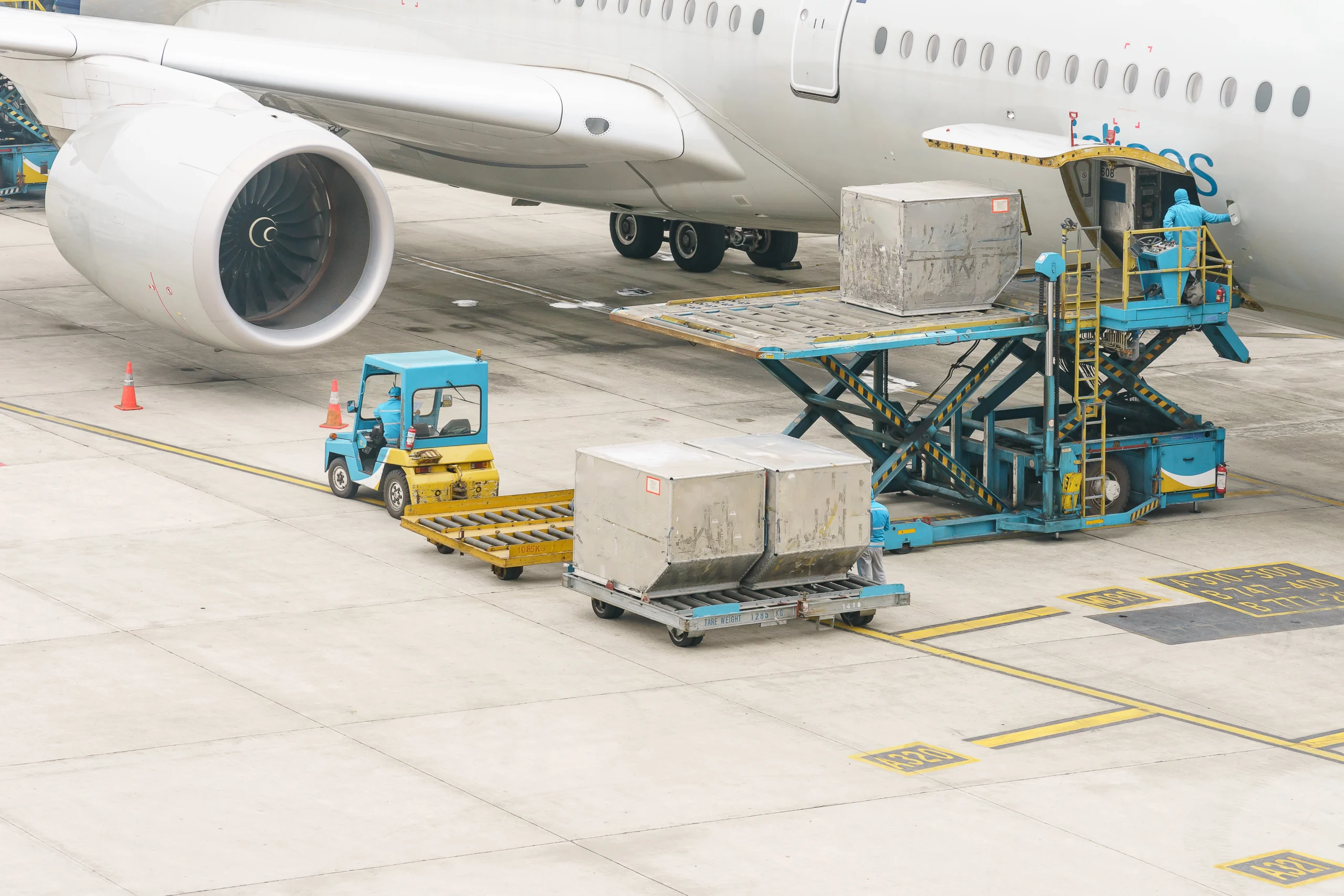
Air freight is commonly used for:
- Urgent commercial goods
- High-value items
- Replacement components
- Seasonal stock
- Time-sensitive samples
- Lighter cargo with strict deadlines
Air freight may be faster than sea freight, but the quotation can depend heavily on chargeable weight, cargo dimensions, route and service level.

Sea Freight
Sea freight is often considered for:
- Large shipment volumes
- Palletised goods
- Containerised cargo
- Machinery
- Furniture
- Non-urgent inventory
- Regular import or export movements
Common arrangements may include:
- Full Container Load: One shipper uses a full container.
- Less than Container Load: Goods from multiple shippers are consolidated into one container.
Besides the main ocean freight charge, shippers should check for origin handling, documentation, port, customs, destination and final-delivery fees.
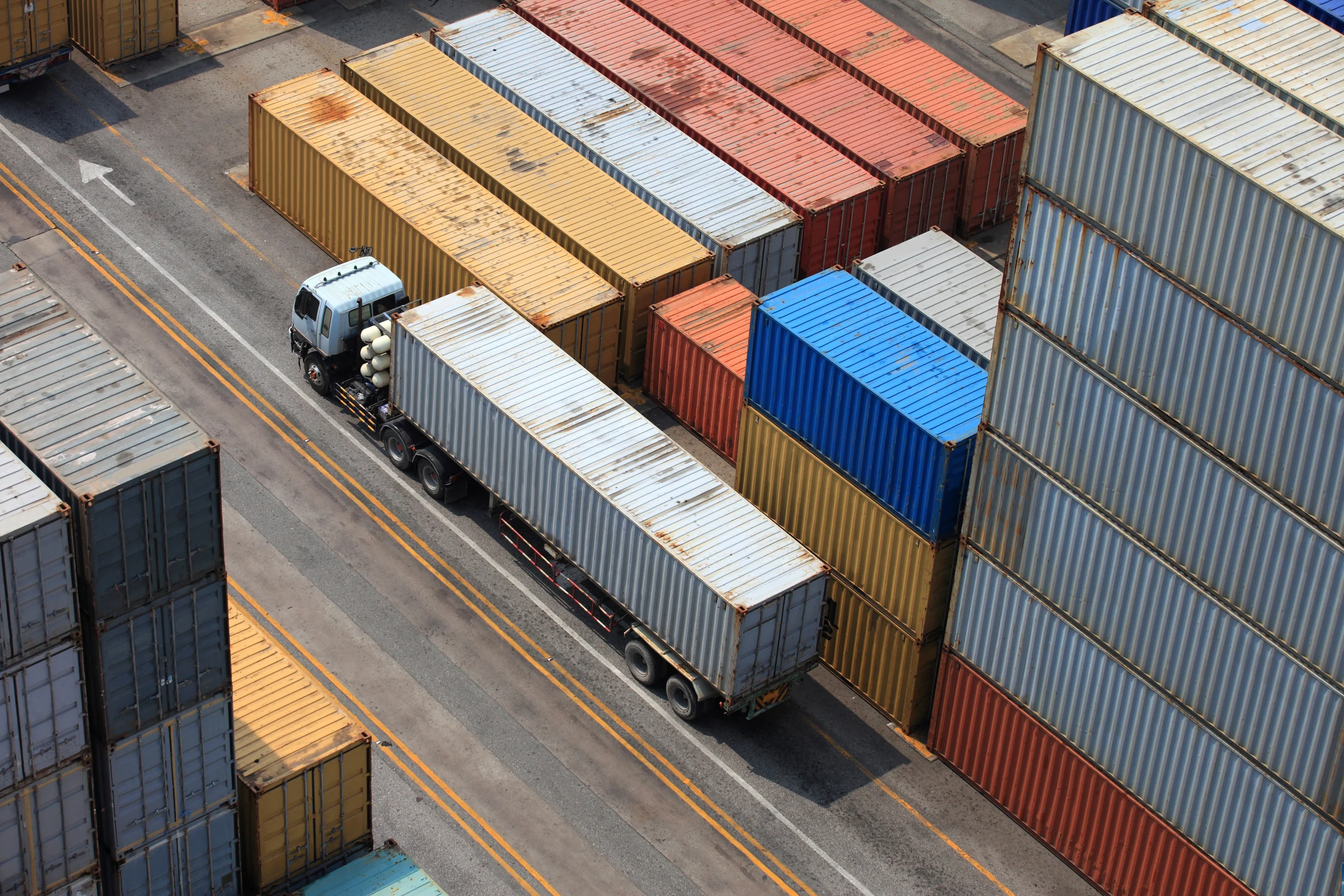
Road Freight
Road freight may support:
- Domestic transportation
- Cross-border regional deliveries
- Port-to-warehouse movement
- Airport collection
- Pallet delivery
- First-mile or last-mile cargo transportation
For shipments moving within Southeast Asia, road transportation may also form one stage of a larger multimodal route.

Cargo Consolidation
Consolidation combines smaller shipments from different shippers into a larger freight movement.
This may be suitable for businesses that:
- Cannot fill an entire container
- Ship smaller commercial volumes
- Want scheduled freight departures
- Can accept a longer handling process
Ask how often consolidation departures operate and whether the cargo will be handled or transferred at intermediate facilities.

Warehousing and Fulfilment
Some freight and forwarding companies also offer:
- Temporary storage
- Long-term warehousing
- Inventory management
- Palletisation
- Labelling
- Order fulfilment
- Pick-and-pack services
- Distribution to multiple destinations
Businesses should determine whether these services are managed directly by the provider or outsourced to another warehouse operator.
Air Freight vs Sea Freight vs International Courier
Businesses should select a shipping solution based on cargo characteristics rather than choosing one method for every international shipment.
| Factor | Air Freight | Sea Freight | International Courier |
|---|---|---|---|
| Best For | Urgent commercial cargo | Large or heavy cargo | Parcels and eCommerce orders |
| Typical Speed | Fast | Slower | Fast to moderate |
| Shipment Size | Cartons and commercial cargo | Pallets and containers | Documents and parcels |
| Booking Complexity | Moderate | Higher | Lower |
| Door-to-Door Availability | Can be arranged | Can be arranged | Common |
| Customs Support | Usually available | Usually available | Often incorporated into the delivery process |
| Tracking Detail | Milestone-based or detailed | Often milestone-based | Commonly parcel-level |
| Best Starting Point | Freight forwarder | Freight forwarder | Courier comparison platform |
When EasyParcel May Be the Better Starting Point
EasyParcel is a shipping platform, not a freight forwarder or courier company.
It is particularly relevant when a business wants to compare and book participating courier services for:
- International parcels
- Documents
- Product samples
- eCommerce orders
- Individual commercial cartons
- Recurring door-to-door shipments
Traditional freight forwarding may remain more suitable for:
- Full containers
- Large palletised cargo
- Oversized machinery
- Project cargo
- Highly specialised goods
- Complex multimodal movements
Businesses shipping several cartons should compare both parcel courier and freight options. The most suitable choice depends on shipment dimensions, urgency, cargo type and total landed cost.
Useful EasyParcel Features for International Parcel Shipping

Compare Available Delivery Services
Compare courier rates, delivery times, pickup options and service features in one place.

Auto Pre-filled Address
Paste the recipient’s full details and let Smart Address fill the address fields automatically.

Auto Generate HS Code
Get an automatic HS code suggestion based on the item name entered.

Duties and Taxes Visibility
Estimate possible import duties and taxes before booking an international shipment.

EasyTrack
Track shipments from different couriers through one centralised platform.

EasyCover
Add optional parcel protection for eligible shipments, subject to applicable terms.

Bulk Upload
Create up to 1,000 shipments at once using single or multiple pickup addresses.

Shipping Integrations
Sync orders from supported eCommerce platforms to reduce manual order entry.
How to Book an International Courier Shipment Through EasyParcel
For parcel-sized shipments that do not require a traditional freight-forwarding arrangement, follow this booking flow.
1. Log in EasyParcel account.
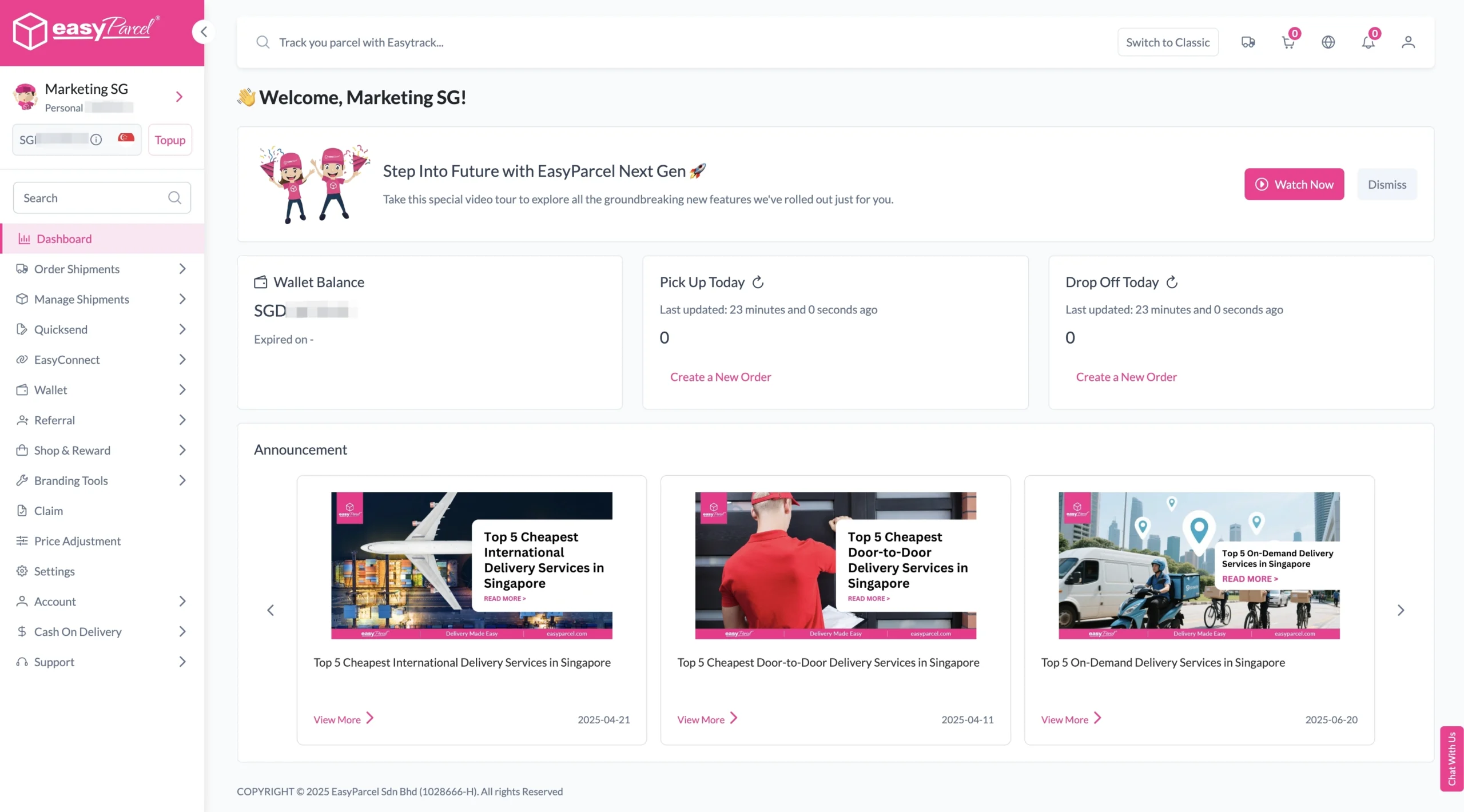
2. Under “Send Parcel”, Click on “International Delivery”.
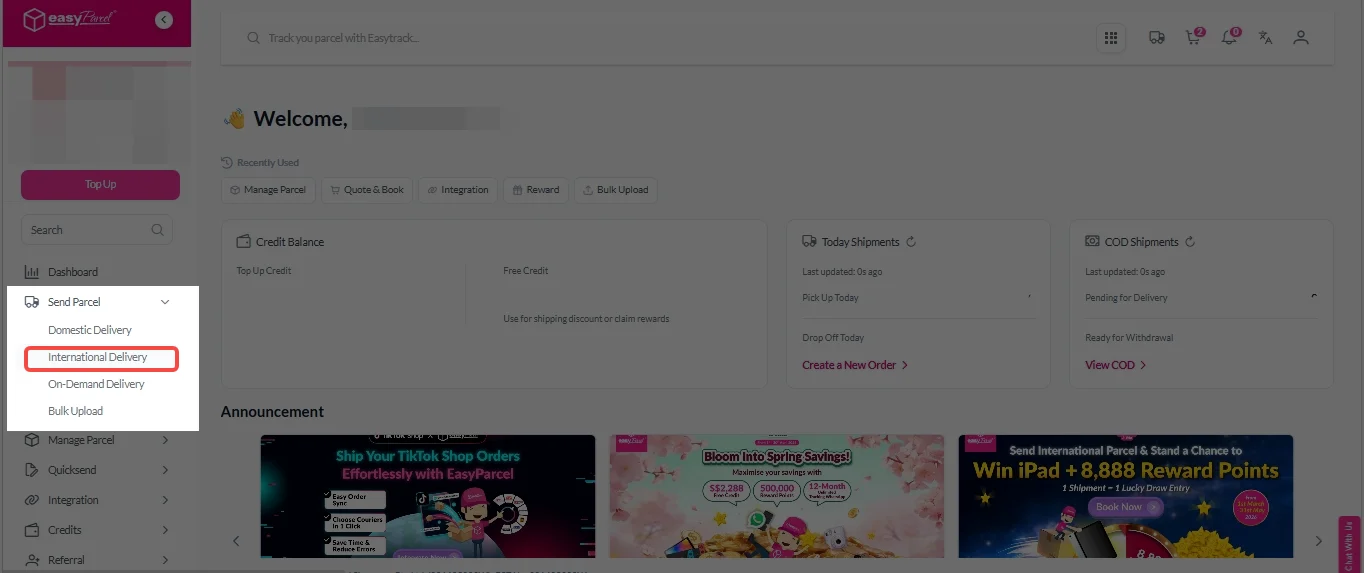
3. Enter details (sender country with postcode, destination country with postcode and parcel weight) and click on “Quote”.
Choose your preferred courier and click “Book Now.”
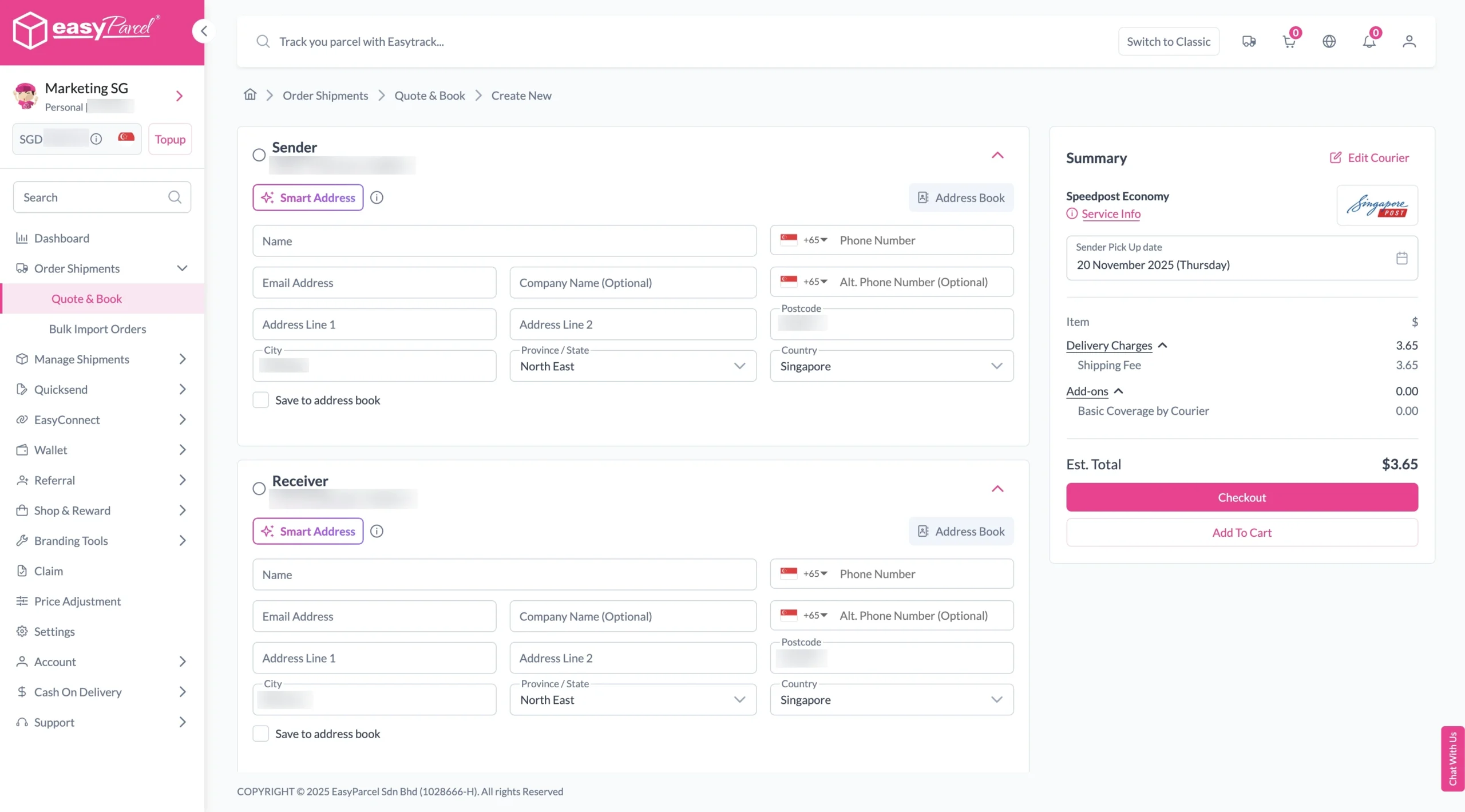
4. Fill in all details included Sender Details, Receiver Details, Parcel Details and Add-On Services.
Sender and Receiver Details:
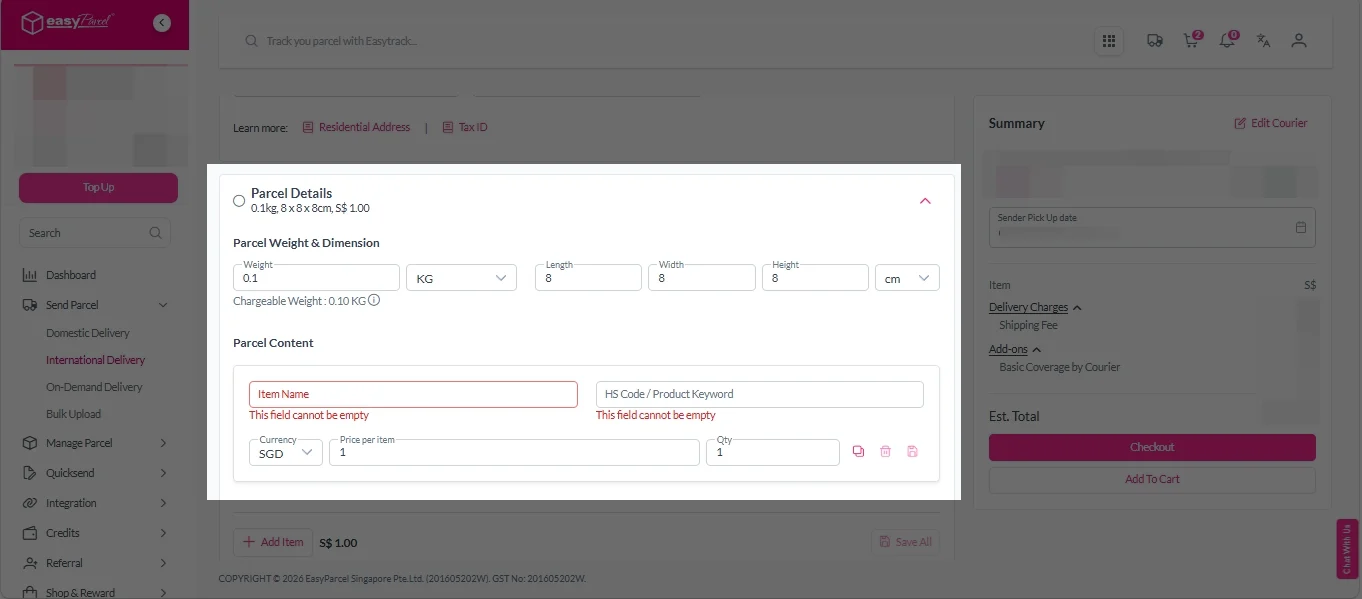
Parcel Details:
Enter the actual weight, dimension and content of your parcel.
Parcel Content:
Fill in your item name. Then, choose your item category from the dropdown menu. The HS code will be auto generated based on your selection.
Note: Learn more about Smart HS Code.
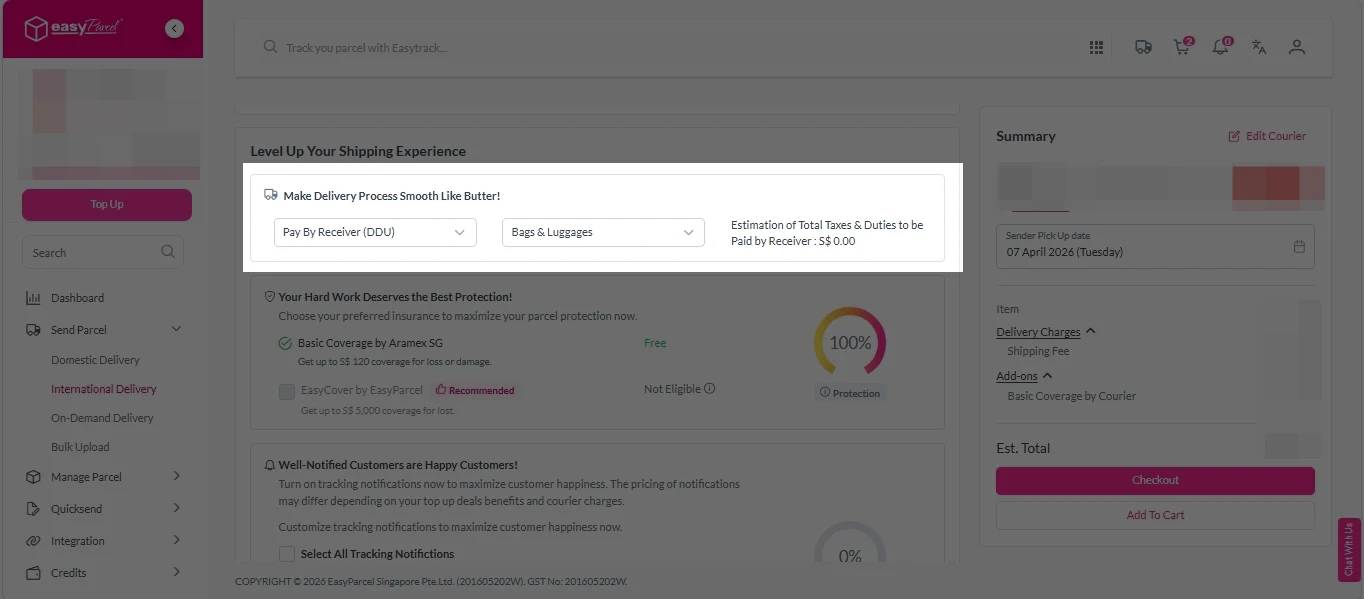
Add-On Services:
i. Select your preferred duties payment option – Delivered Duty Paid (DDP) or Delivered Duty Unpaid (DDU).
Note: Learn more about DDP and DDU.
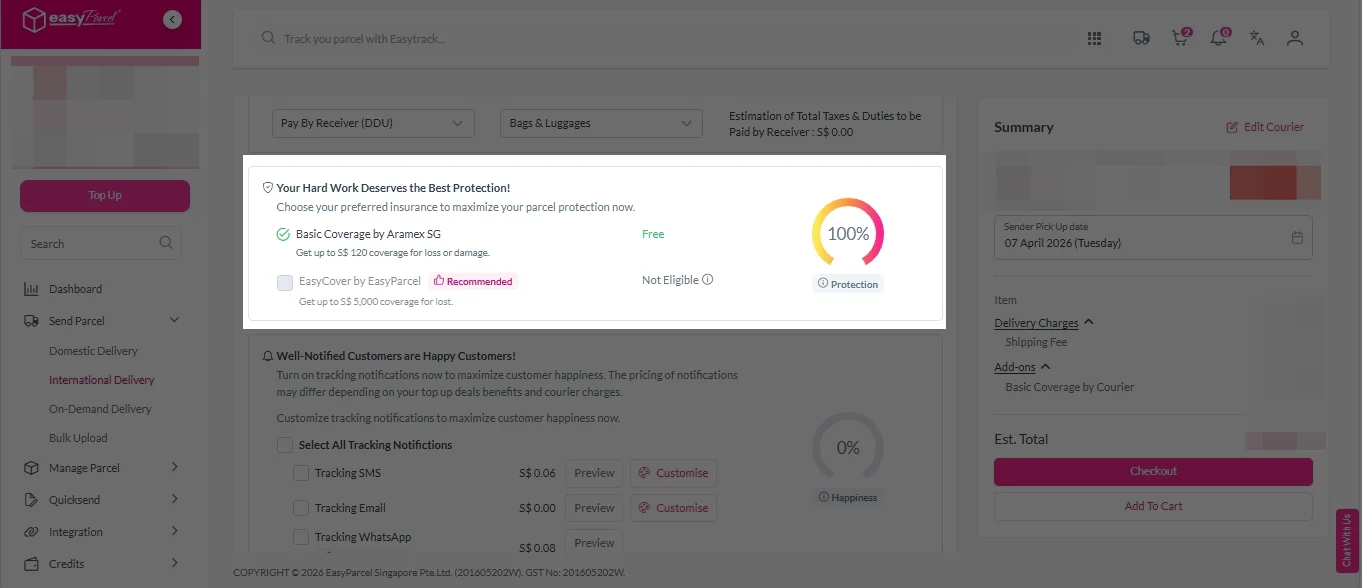
ii. Tick the box to add EasyCover for additional protection against loss.
Note: EasyCover availability depends on the courier selected. Learn more about EasyCover.
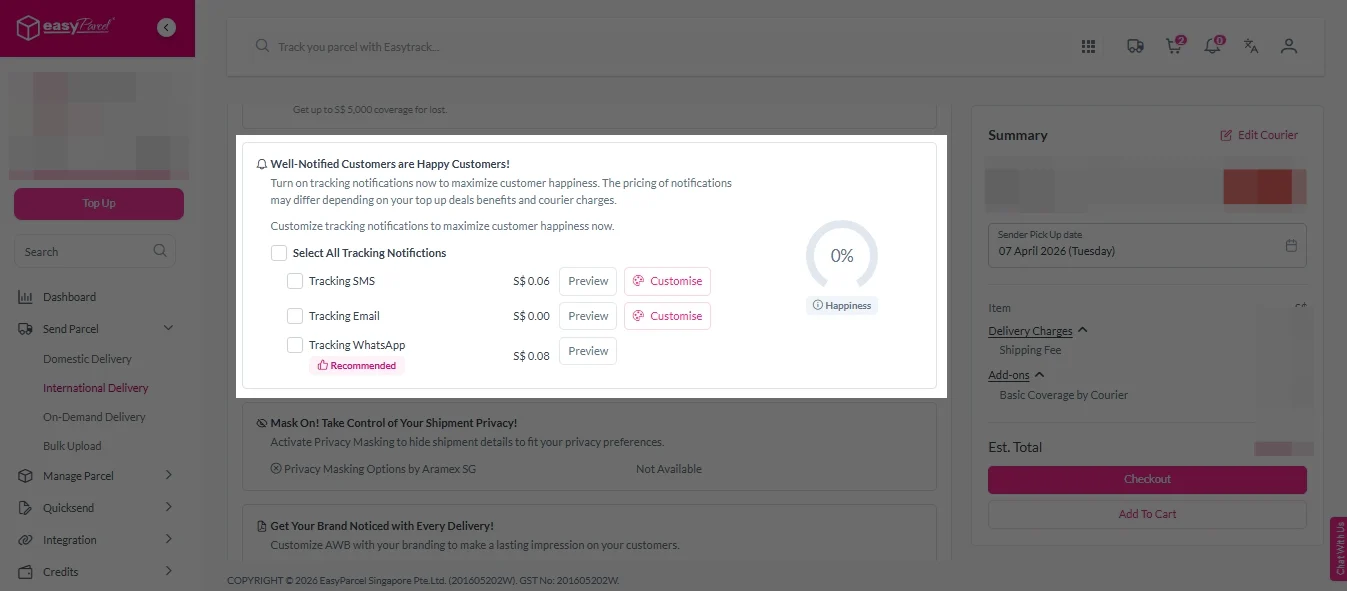
iii. Choose your preferred notification channel – SMS, Email, or WhatsApp. Click “Preview” to see how it looks, and click “Customise” to add brand message to the notification.
Note: Learn more about Customise Branding Servcies.
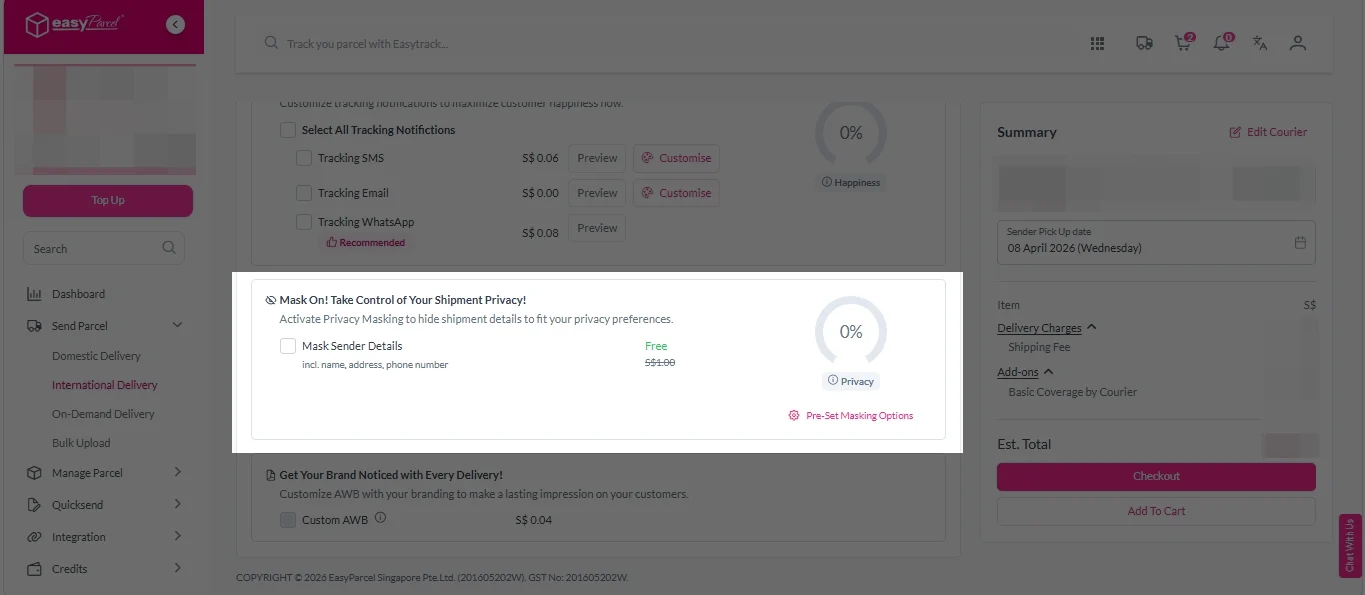
iv. Tick the “Mask Sender Details” checkbox. EasyParcel Next Gen will automatically hide your sender information based on your saved privacy settings.
Note: Mask Sender Details only available for certain couriers. Find out what courier is available for Mask Sender Details.
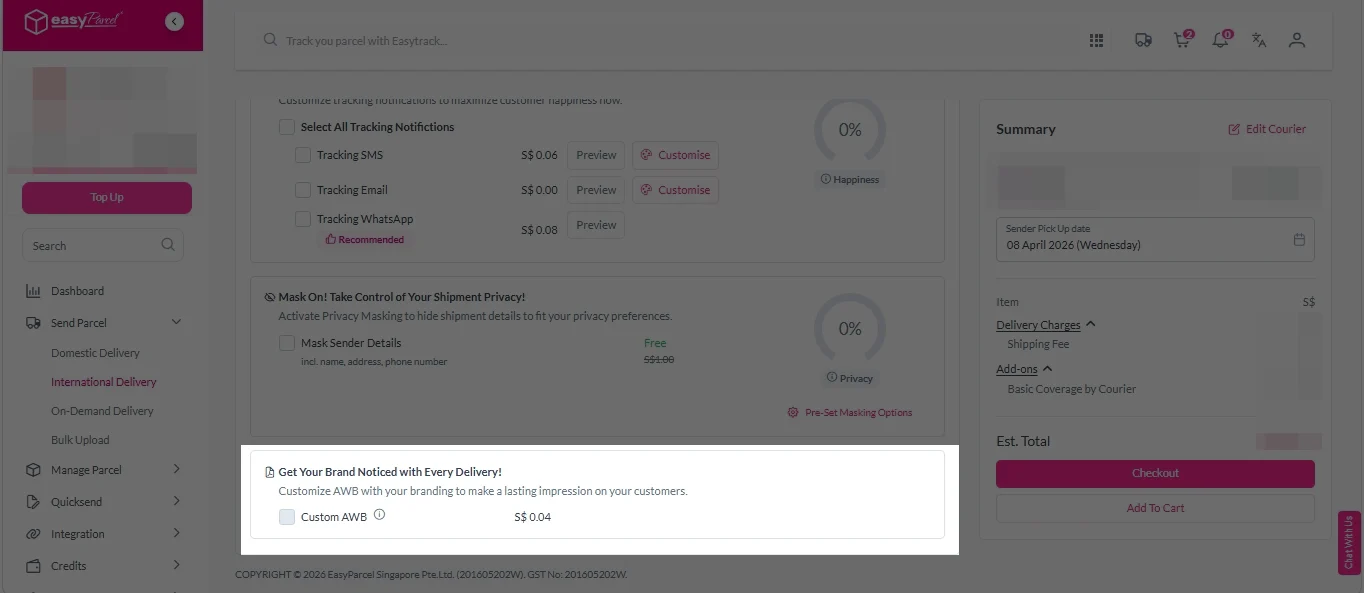
v. Tick the “Custom AWB” checkbox. EasyParcel Next Gen will apply your saved AWB template automatically. After completing all details, click on “Checkout” button.
Note: Custom AWB is only available for certain couriers. Find out which couriers support Custom AWB.
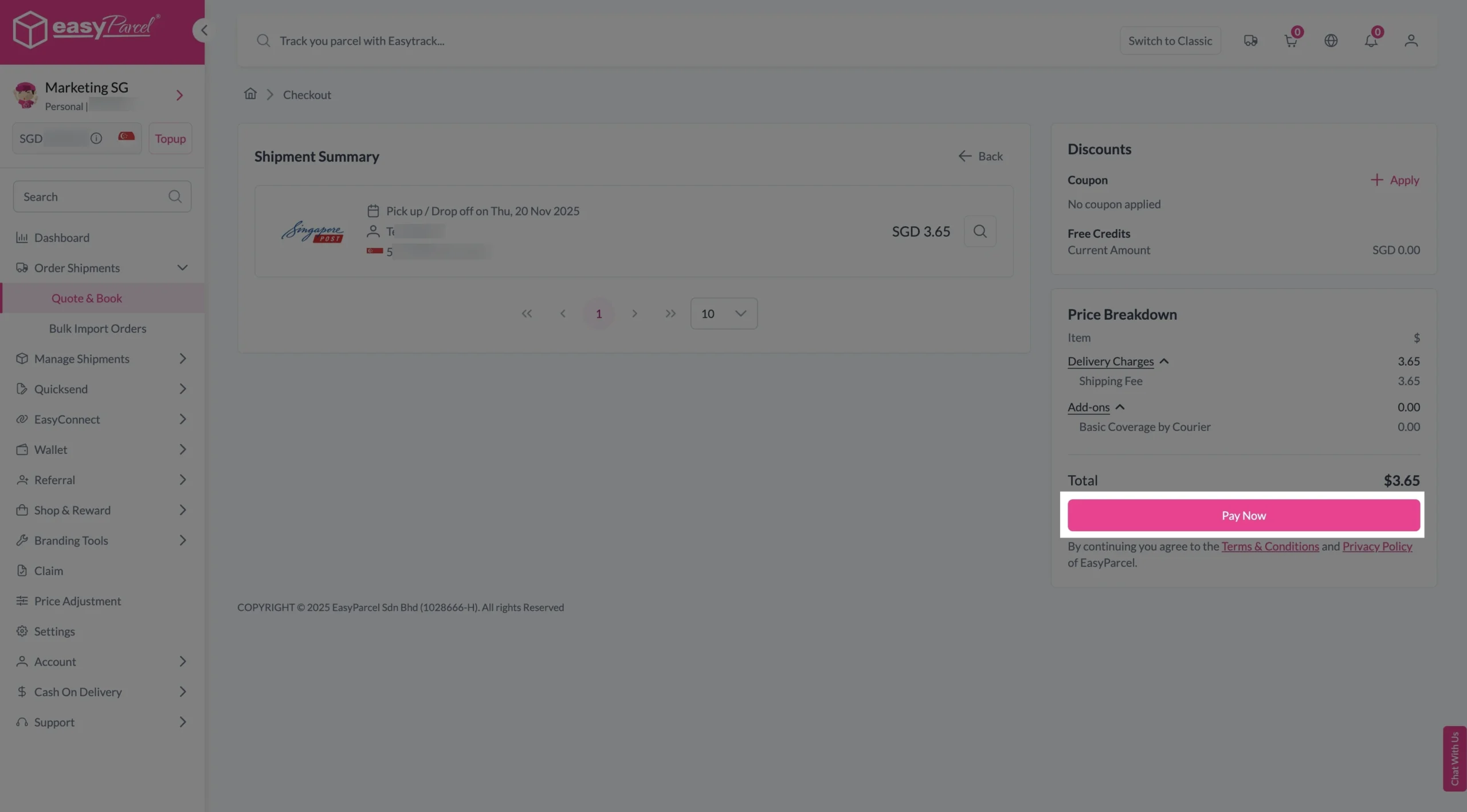
5. Double check all the details and click on “Pay Now” to make payment.
6. Download and print Air Waybill (AWB).
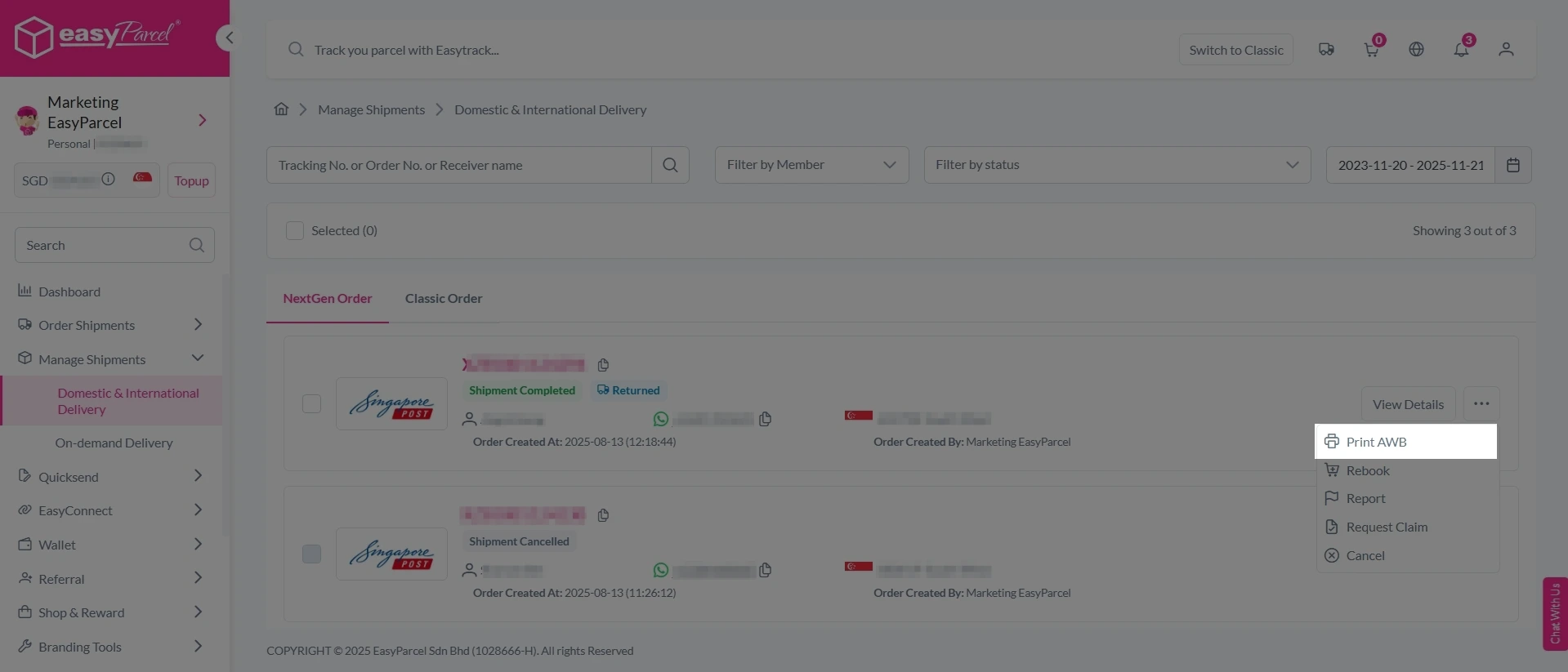
Single AWB
1. Click the three dots icon next to the shipment.
2. Select “Print AWB” from the dropdown menu.
3. A PDF file will automatically download and save.
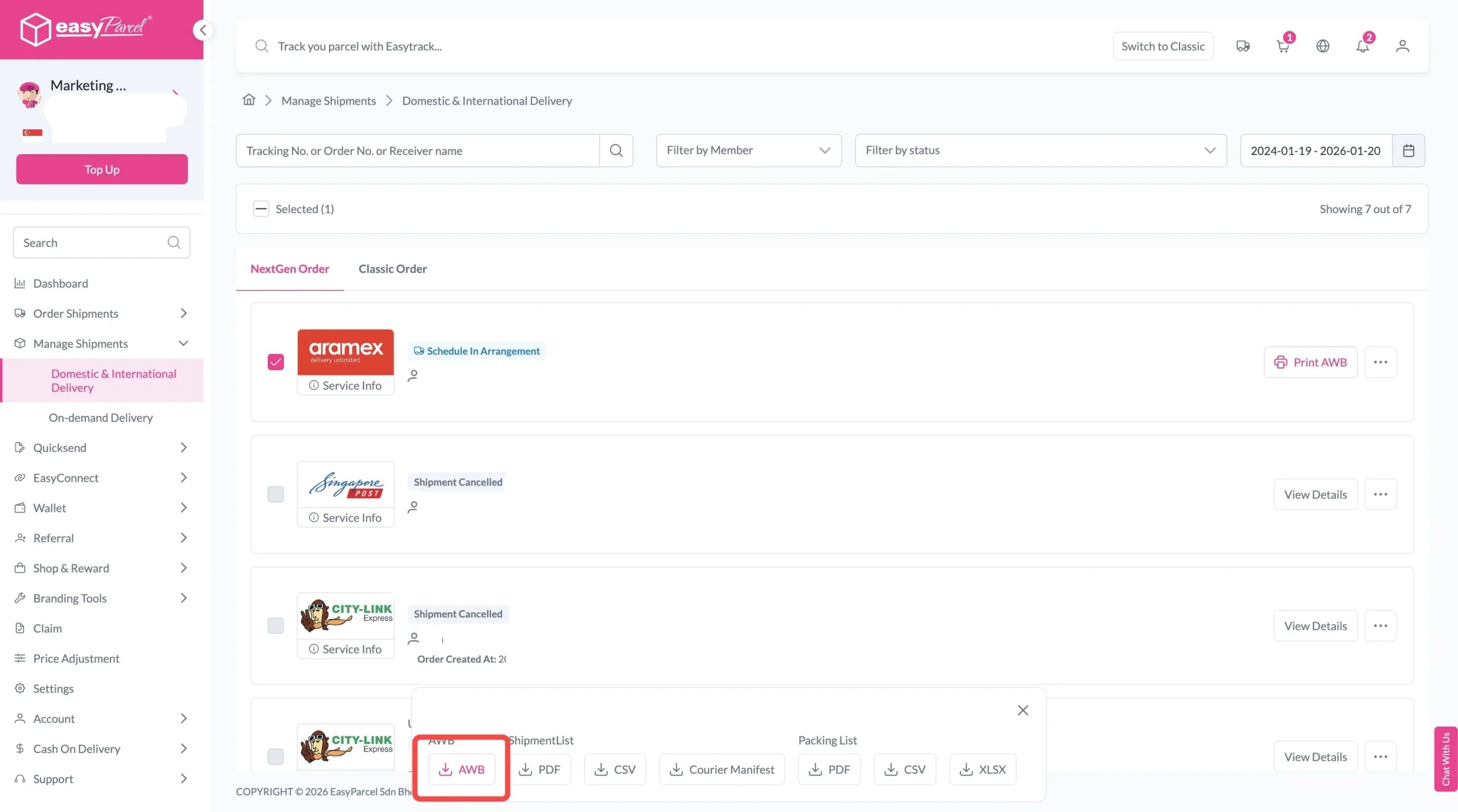
Bulk Downloads AWB
1. Tick the “Selected” checkbox to choose all your orders.
2. A menu will appear at the bottom of the screen.
3. Click “AWB” to download all AWBs in bulk.
Conclusion
Choosing among freight and forwarding companies requires more than comparing advertised prices.
Businesses should review each provider’s route experience, cargo capability, customs knowledge, quotation scope, tracking, claims support, destination network and ability to scale. A suitable provider should clearly explain what is included, what remains the shipper’s responsibility and which costs may change during the shipment.
For pallets, containers, oversized goods and complex multimodal cargo, a specialist freight forwarder may be the right choice. For documents, eCommerce orders, samples and parcel-sized international shipments, an online shipping platform may provide a more convenient way to compare and book courier services.
The most effective approach is to begin with the shipment itself: define the cargo, route, deadline, service scope and regulatory requirements, then select the provider model that best fits those needs.