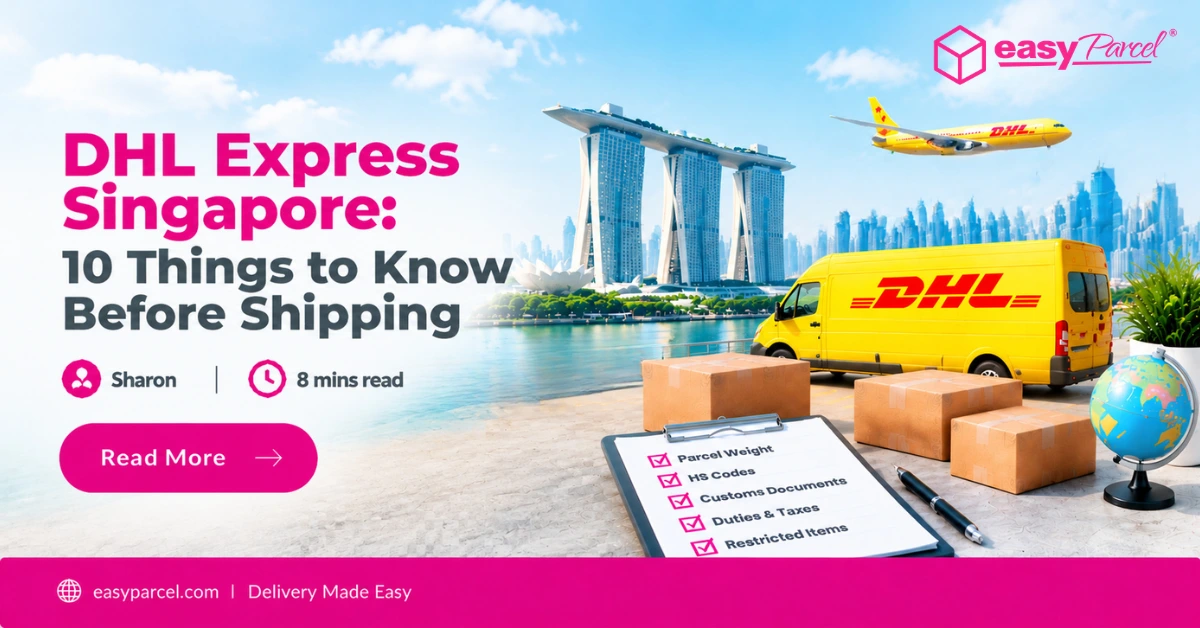
DHL Express Singapore: 10 Things to Know Before Shipping Overseas
Sending a parcel overseas isn’t just about choosing a courier and paying the shipping fee.
Before using DHL Express Singapore, you’ll need to consider your parcel size, customs declaration, HS Code, destination restrictions, duties and taxes, packaging and several other details.
Getting these right can help reduce the risk of avoidable customs or delivery issues.
So, before you send your next international parcel, use this 10-point shipping checklist to make sure you’re prepared.
Table of Contents
1. Check Whether Your Item Can Be Shipped
Before comparing prices, first determine whether your item is accepted for international delivery.
DHL maintains restrictions and prohibitions covering certain commodities, while some goods may only be accepted subject to specific conditions or prior approval.
Items requiring extra attention can include:
- Batteries
- Liquids
- Perfumes
- Food
- Medicines
- Valuable items
- Dangerous goods
Don’t assume that an item accepted for local delivery can automatically be shipped internationally.
You should also check the destination country’s import restrictions, as these can differ from Singapore’s export requirements.
2. Measure Your Parcel Correctly
International shipping rates can depend on more than actual weight.
Couriers may compare your parcel’s actual weight against its volumetric weight when determining the chargeable weight.
DHL Express calculates volumetric weight using:
Length (cm) × Width (cm) × Height (cm) ÷ 5,000
For example, imagine your parcel measures:
40cm × 30cm × 30cm
Its volumetric weight would be:
40 × 30 × 30 ÷ 5,000 = 7.2kg
Even if the parcel physically weighs only 4kg, its size can therefore affect how the shipment is charged.
Tip: Measure your parcel after it has been completely packed, rather than measuring only the product.
3. Pack Your Parcel for International Transit
International parcels can travel through several facilities, vehicles and aircraft before reaching the recipient.
Proper packaging is therefore important.
Use:
- A strong outer box
- Suitable internal cushioning
- Strong packing tape
- Properly sealed edges
- Appropriate packaging for fragile products
Avoid leaving large empty spaces inside the box, as the contents may move during transportation.
Choosing a right-sized box can also help keep volumetric weight under control.
4. Prepare an Accurate Item Description
Writing “gift”, “sample” or “accessories” alone may not adequately describe what’s actually inside the parcel.
Customs declarations generally require clear information about the shipment’s contents.
Instead of:
❌ Clothes
Consider a more specific description such as:
✅ Men’s cotton T-shirt
Instead of:
❌ Accessories
Use something more descriptive, such as:
✅ Stainless steel fashion bracelet
Clear descriptions can also help with assigning the appropriate customs classification.
5. Find the Correct HS Code
If you’re sending goods internationally, you’ll frequently encounter the term HS Code.
The Harmonized System is an international product-classification system administered by the World Customs Organization and used by customs authorities around the world.
An HS Code helps customs identify what you’re shipping and can affect:
- Import duties
- Taxes
- Customs clearance
- Restrictions
- Documentation requirements
For example, two products that look similar could potentially have different classifications because of their materials or intended uses.
Avoid simply copying an HS Code from an unrelated product.
6. Declare the Correct Shipment Value
International shipments generally require a declared value for customs purposes.
This should accurately reflect the goods being shipped.
Don’t deliberately undervalue your parcel just to try to reduce import taxes.
Incorrect declarations can create customs issues and may also affect other aspects of the shipment.
If you’re selling products internationally, keep your commercial invoice and declared information consistent.
7. Prepare Your Commercial Invoice
A commercial invoice is one of the key documents used for international shipments involving goods.
It typically contains information such as:
| Information | Example |
|---|---|
| Sender | Singapore business/sender details |
| Recipient | Overseas customer’s details |
| Item | Cotton T-shirts |
| Quantity | 5 |
| Value | S$100 |
| Country of origin | Singapore |
| HS Code | Applicable classification |
| Shipping purpose | Sale / Sample / Other |
The exact documentation required depends on the shipment and destination.
Incomplete or inconsistent customs documentation can lead to additional queries during clearance.
8. Understand Duties & Taxes Before Shipping
Your courier fee isn’t necessarily the recipient’s final cost.
The destination country may impose:
- Import duties
- VAT/GST
- Sales taxes
- Customs fees
- Other applicable charges
The amount depends on factors such as:
Product + HS Code + Value + Origin + Destination + Applicable Tax Rules
This is particularly important for eCommerce businesses.
Imagine your customer pays S$100 for a product and then unexpectedly receives a customs bill upon arrival. Even if the courier delivered perfectly, the customer experience may still suffer.
That’s why understanding potential landed costs before shipping is useful.
9. Double-Check the Recipient's Details
One small address mistake can create a large international delivery problem.
Before confirming your shipment, verify:
✓ Recipient’s full name
✓ Street address
✓ Unit or apartment number
✓ City
✓ State/province where applicable
✓ Postal code
✓ Country
✓ Phone number
✓ Email address where required
Don’t rely on autofill without checking the information.
For business orders, consider asking customers to verify their delivery information before dispatch.
10. Compare Before You Commit
| Factor | What to Check |
|---|---|
| Price | Total shipping rate |
| Speed | Estimated delivery time |
| Coverage | Whether your destination is supported |
| Parcel limits | Weight and dimensions |
| Pickup | Availability at your location |
| Tracking | Shipment visibility |
| Customs | Documentation requirements |
Ready to Send Your International Parcel?
Then compare available international courier services on EasyParcel to find an option that fits your destination, budget and delivery timeline.

Common International Shipping Mistakes to Avoid
Before sending your parcel, check that you’re not making one of these common mistakes:
❌ Using an oversized box
This may increase your volumetric weight.
❌ Guessing the parcel weight
Always weigh the final packed parcel.
❌ Using vague item descriptions
Provide clear descriptions of the actual goods.
❌ Guessing the HS Code
Incorrect classification can cause customs complications.
❌ Ignoring destination restrictions
An item allowed in Singapore may be controlled elsewhere.
❌ Forgetting duties and taxes
Your shipping rate isn’t necessarily the entire landed cost.
❌ Choosing a courier based only on brand
Compare price, speed and service suitability too.
Can You Book DHL Express Singapore Through EasyParcel?
No. EasyParcel Singapore currently does not provide DHL Express shipping services.
If you specifically want to ship with DHL Express Singapore, you’ll need to check DHL’s official channels for its latest quotation and booking options.
However, if you haven’t decided on a courier yet, EasyParcel can help you compare alternative international shipping services.
This is particularly useful if your priority is simply getting your parcel overseas at a suitable combination of price and delivery speed, rather than using one specific courier brand.
How EasyParcel Makes International Shipping Preparation Easier

Smart HS Code — Find Your Classification
Instead of searching through HS Code tables manually, Smart HS Code can suggest an appropriate code based on your product information.

Duties & Taxes Calculator — Estimate Before Shipping
Get an estimate of potential import duties and taxes so you have better visibility of your international shipment's possible costs.

Compare International Couriers — Don't Check One by One
Enter your shipment information and compare available international courier services based on shipping rates and estimated delivery times.
Pickup or Drop-Off — Choose What's Convenient
Depending on your selected courier service, choose between doorstep pickup or an available drop-off option.

EasyTrack — Follow Your Shipment
Monitor your parcel through EasyTrack from pickup until successful delivery.
How to Book International Shipping with EasyParcel
1. Log in EasyParcel account.
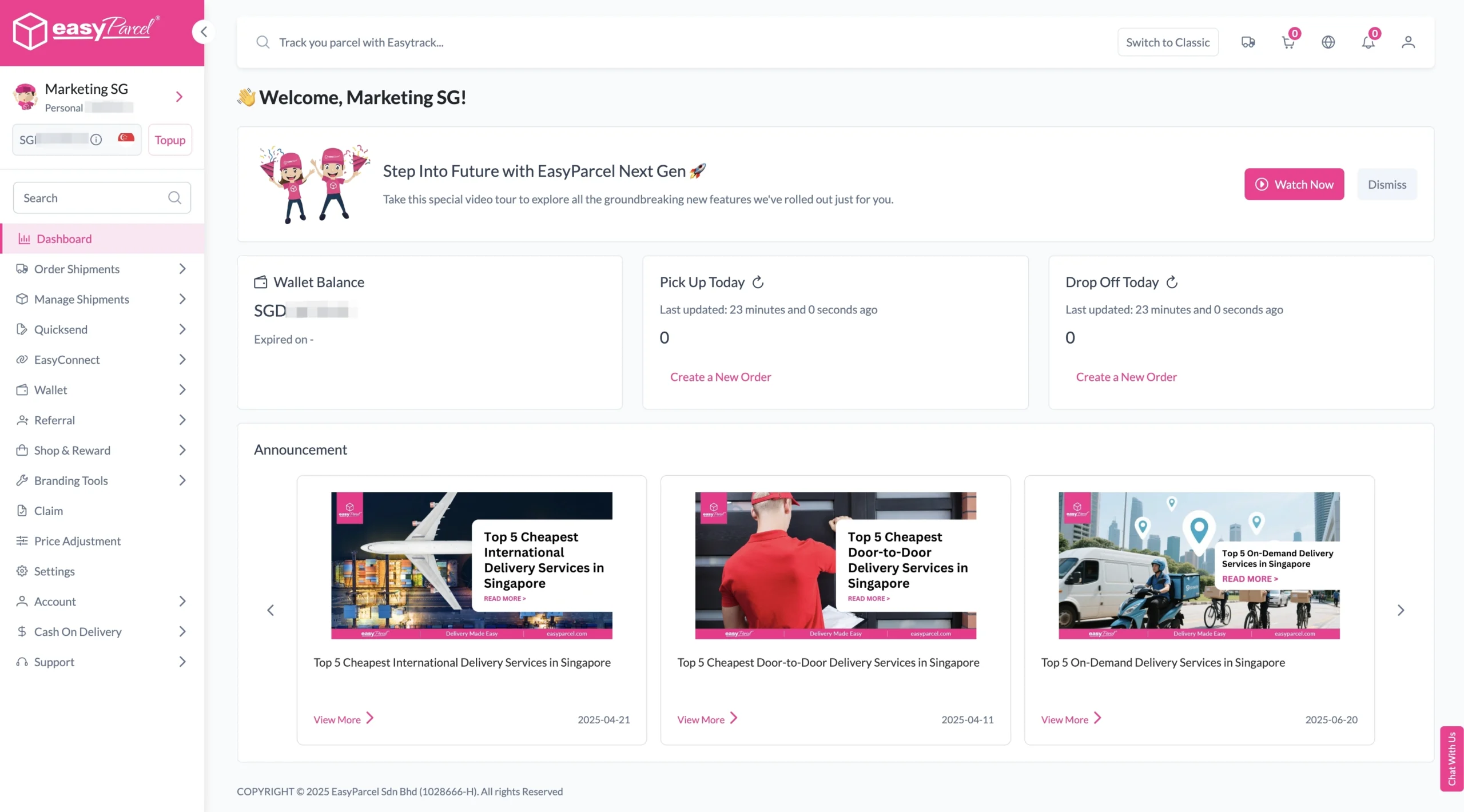
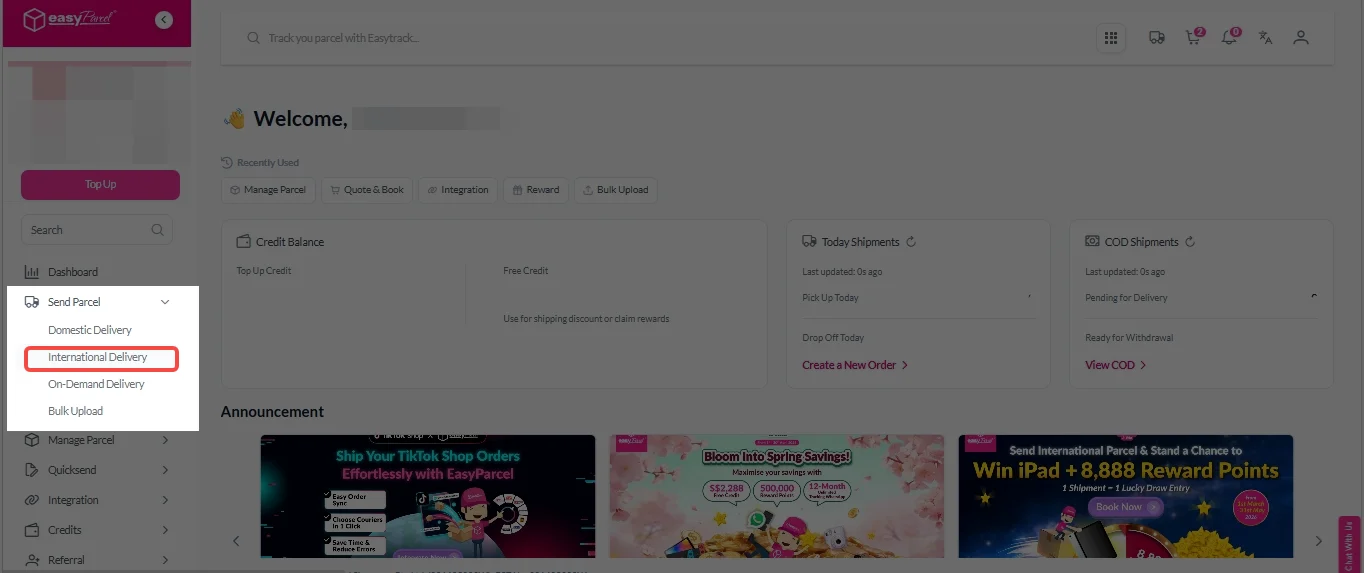
2. Under “Send Parcel”, Click on “International Delivery”.
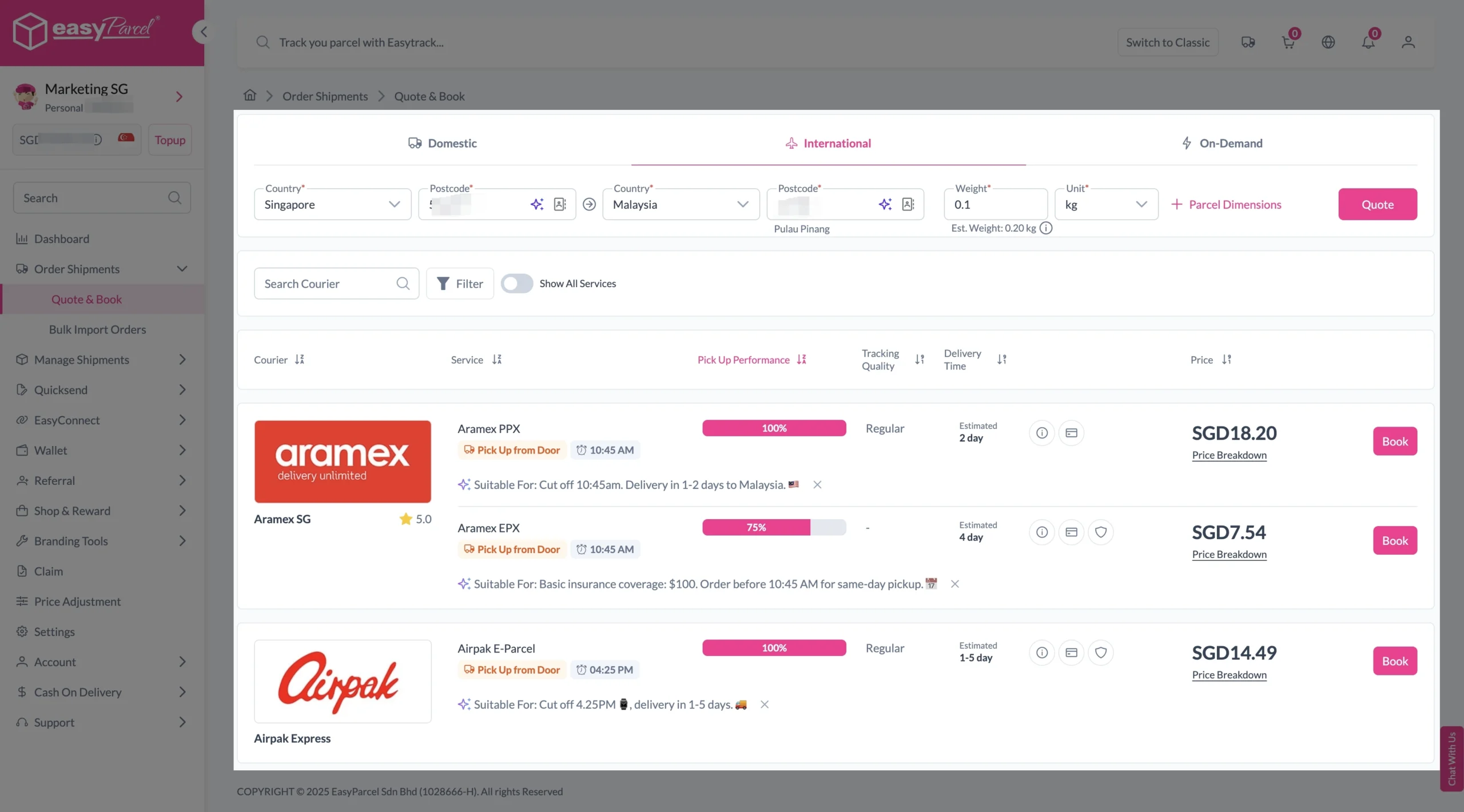
3. Enter details (sender country with postcode, destination country with postcode and parcel weight) and click on “Quote”.
Choose your preferred courier and click “Book Now.”
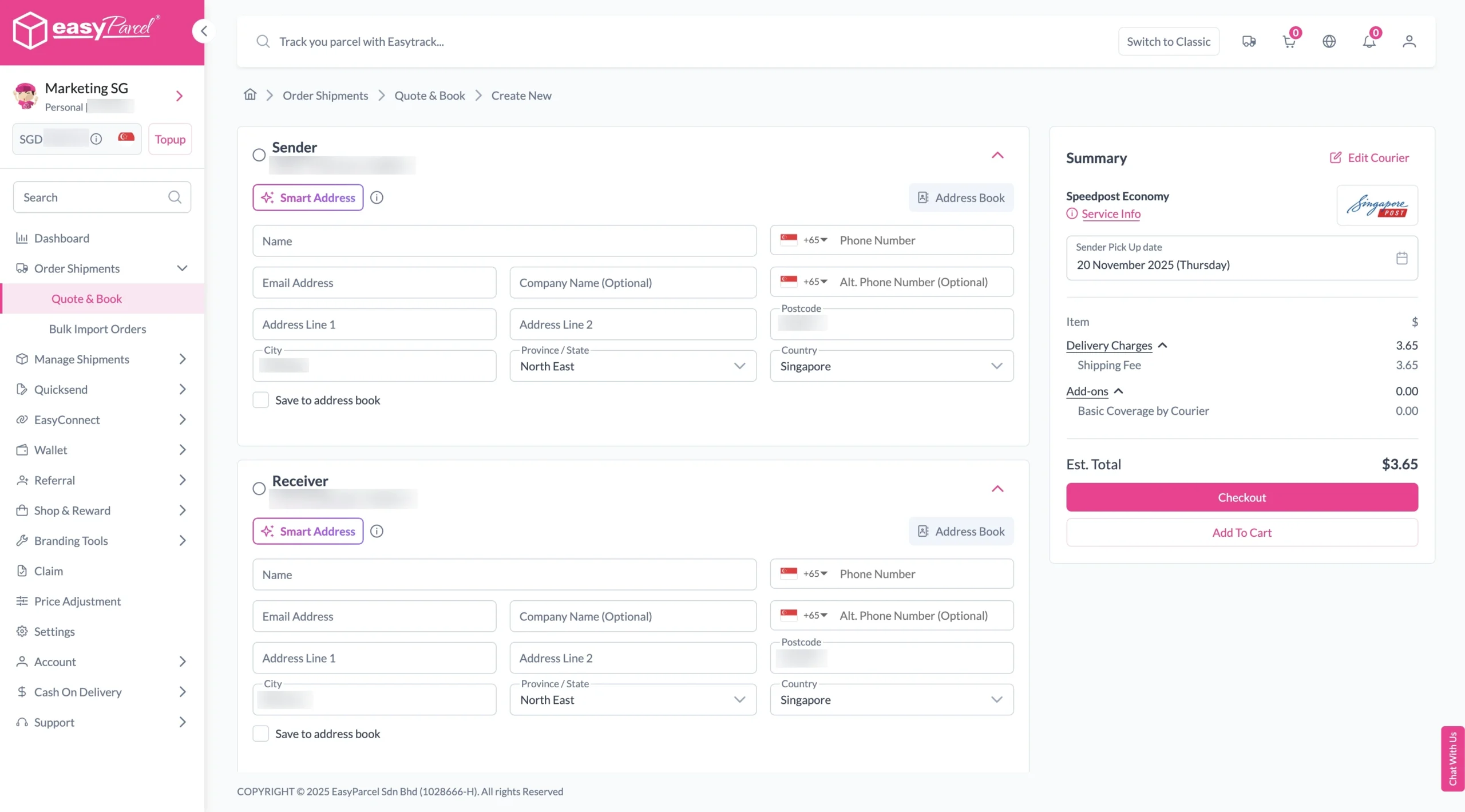
4. Fill in all details included Sender Details, Receiver Details, Parcel Details and Add-On Services.
Sender and Receiver Details:
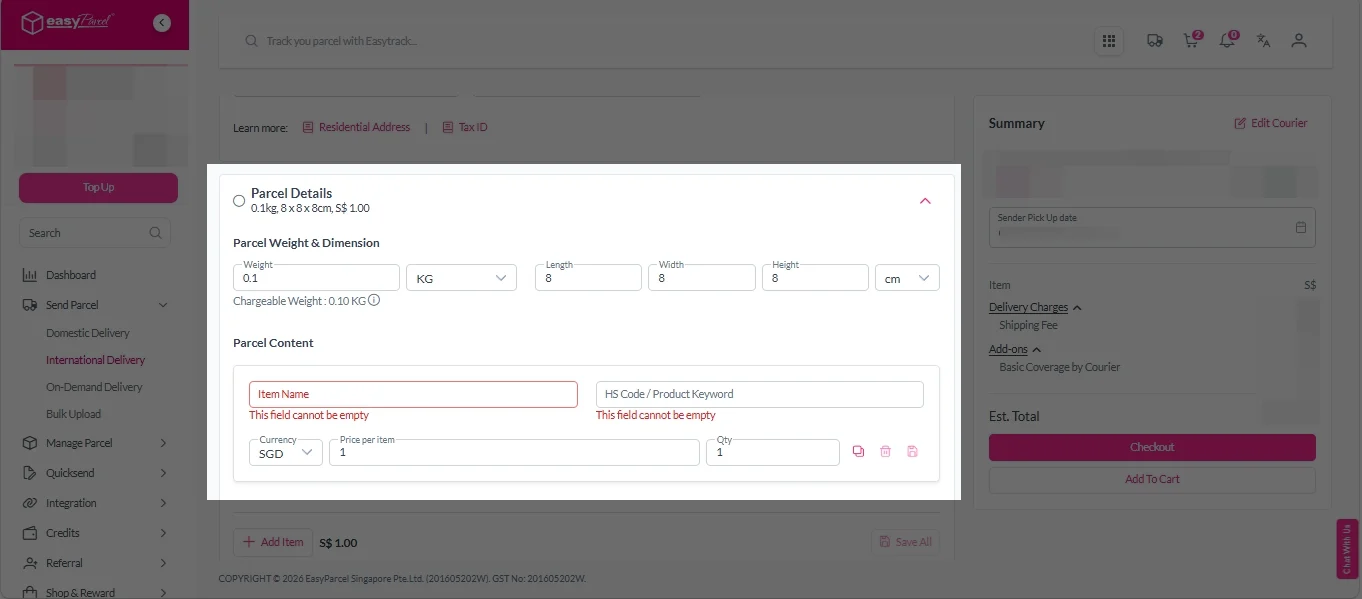
Parcel Details:
Enter the actual weight, dimension and content of your parcel.
Parcel Content:
Fill in your item name. Then, choose your item category from the dropdown menu. The HS code will be auto generated based on your selection.
Note: Learn more about Smart HS Code.
Add-On Services:
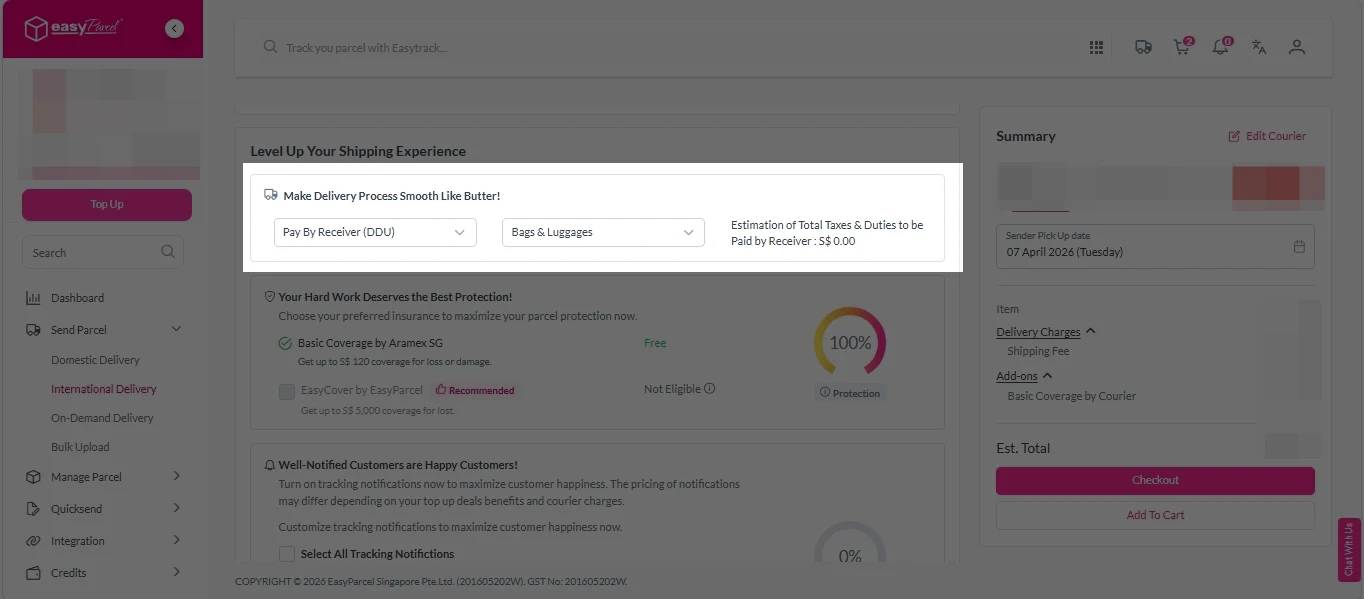
i. Select your preferred duties payment option – Delivered Duty Paid (DDP) or Delivered Duty Unpaid (DDU).
Note: Learn more about DDP and DDU.
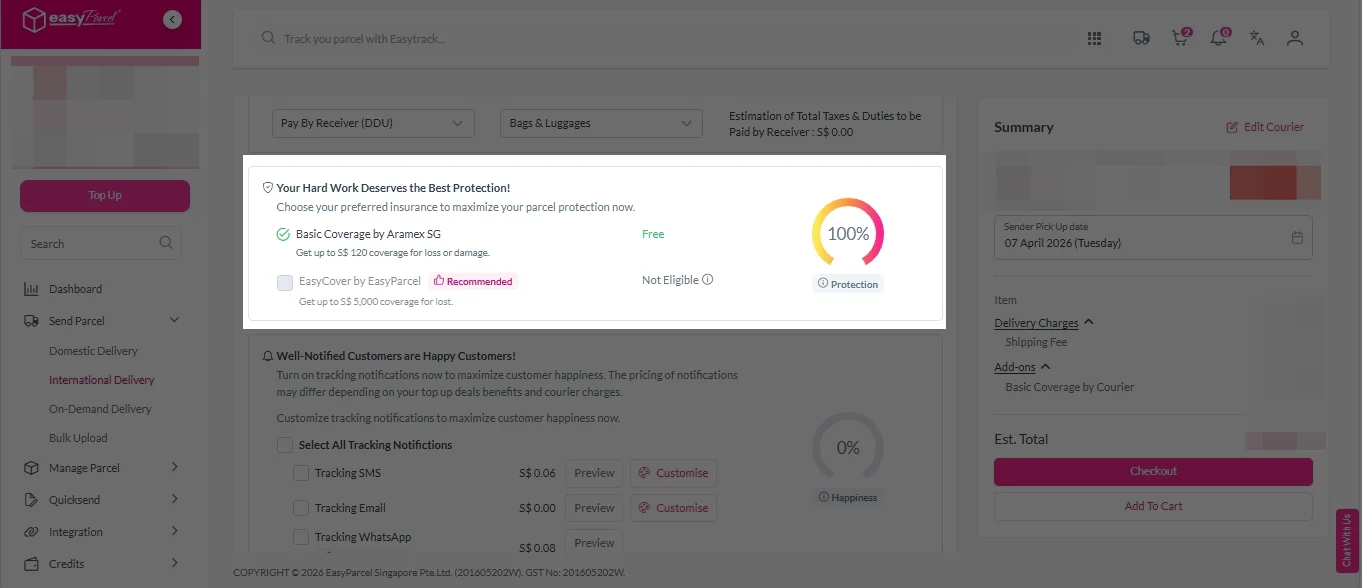
ii. Tick the box to add EasyCover for additional protection against loss.
Note: EasyCover availability depends on the courier selected. Learn more about EasyCover.
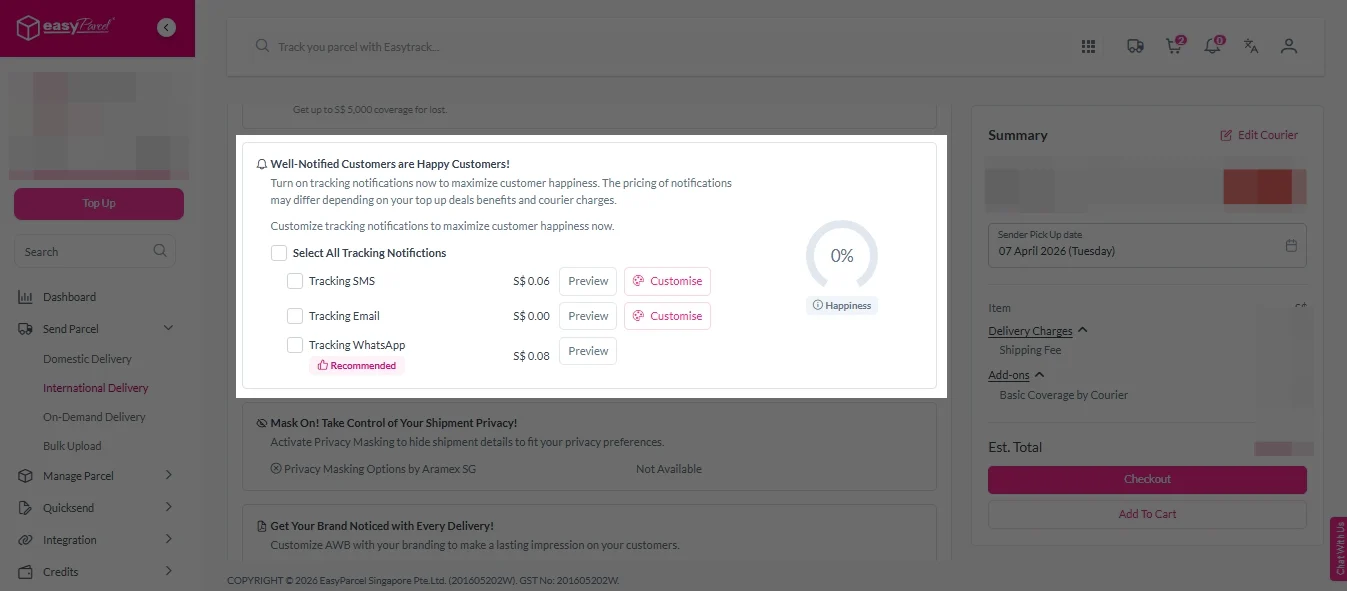
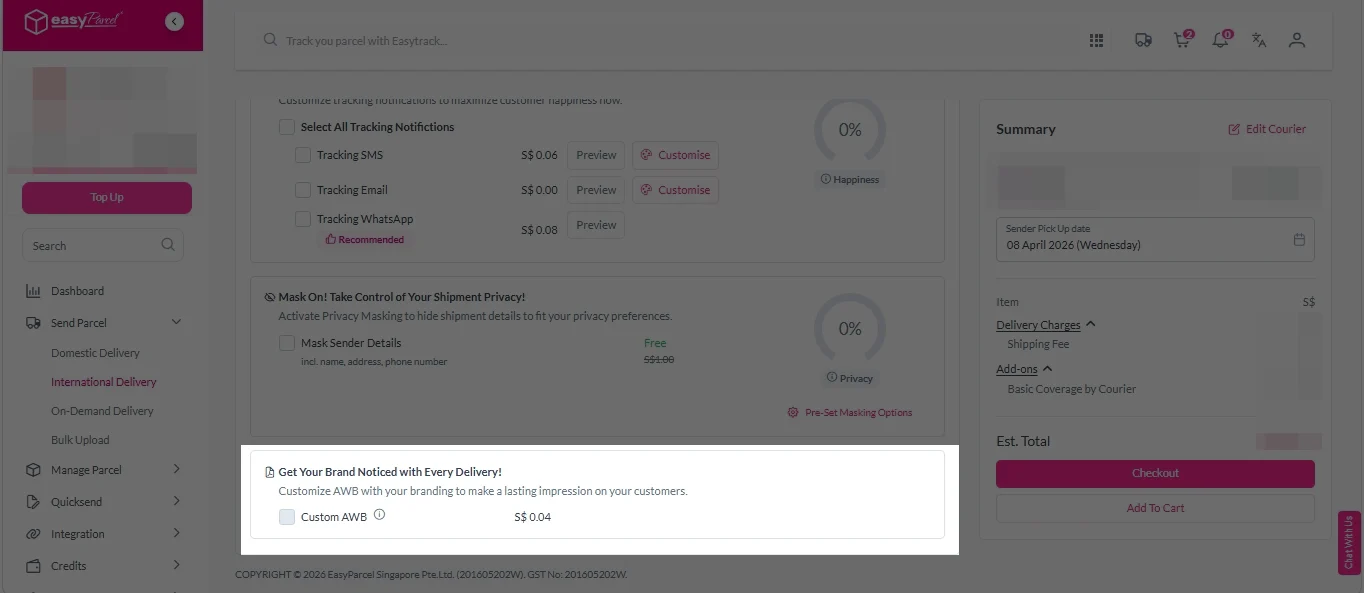
iii. Choose your preferred notification channel – SMS, Email, or WhatsApp. Click “Preview” to see how it looks, and click “Customise” to add brand message to the notification.
Note: Learn more about Customise Branding Servcies.
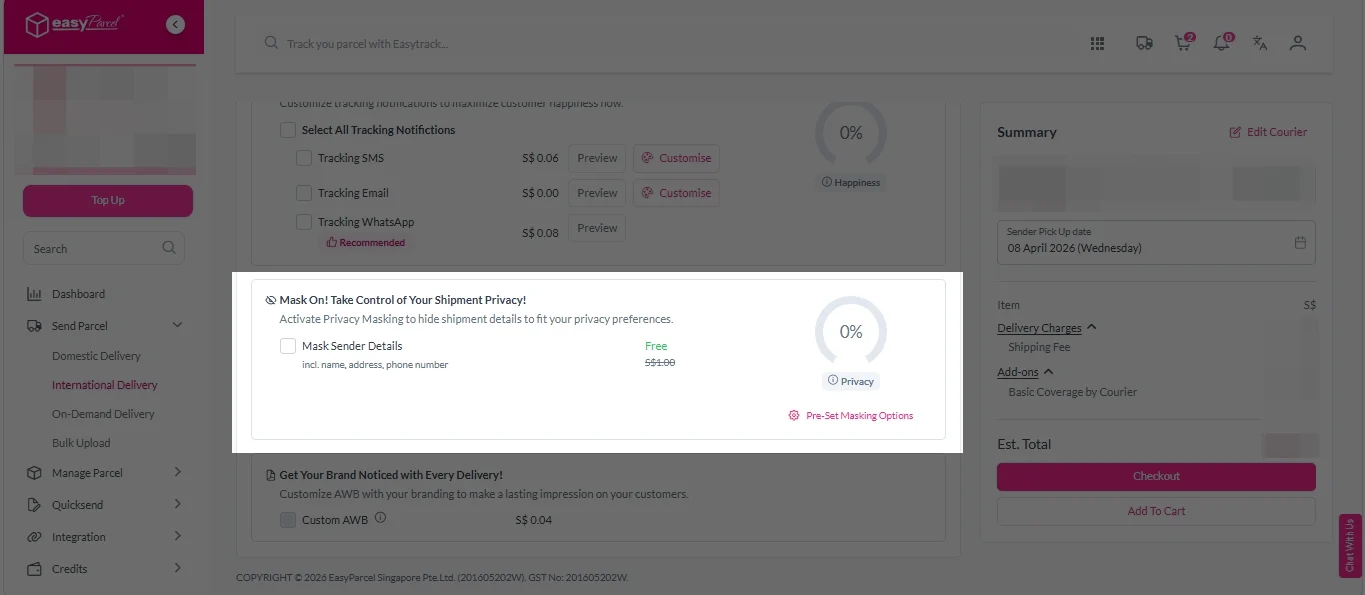
iv. Tick the “Mask Sender Details” checkbox. EasyParcel Next Gen will automatically hide your sender information based on your saved privacy settings.
Note: Mask Sender Details only available for certain couriers. Find out what courier is available for Mask Sender Details.
v. Tick the “Custom AWB” checkbox. EasyParcel Next Gen will apply your saved AWB template automatically. After completing all details, click on “Checkout” button.
Note: Custom AWB is only available for certain couriers. Find out which couriers support Custom AWB.
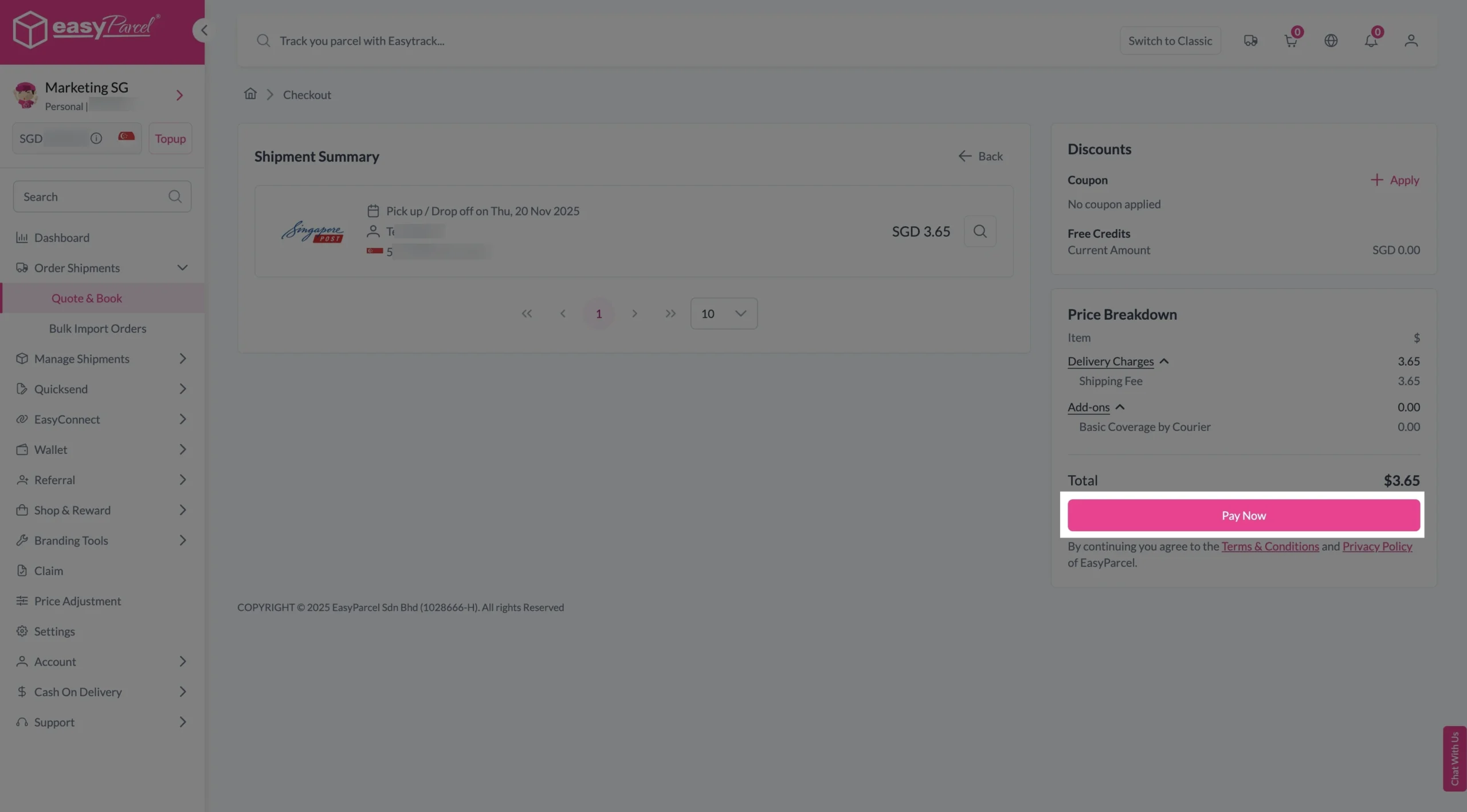
5. Double check all the details and click on “Pay Now” to make payment.
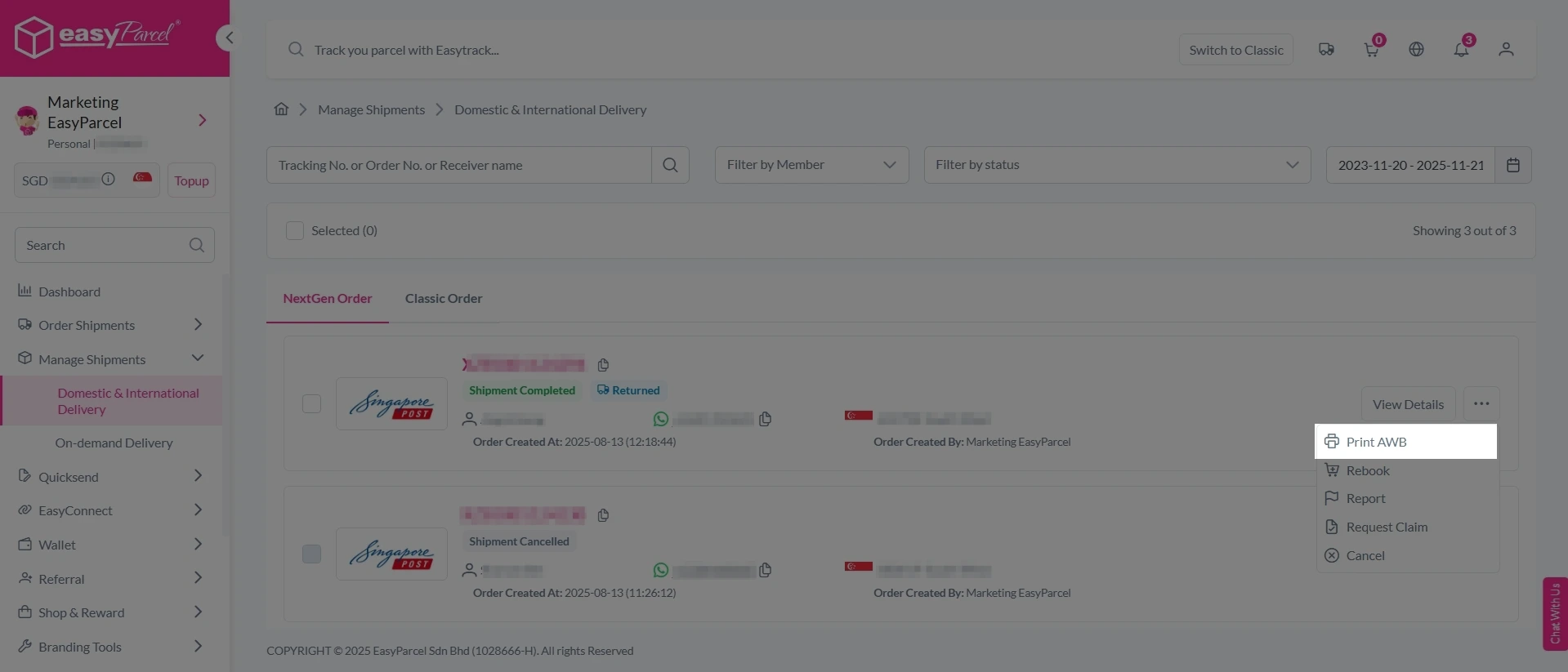
6. Download and print Air Waybill (AWB).
Single AWB
1. Click the three dots icon next to the shipment.
2. Select “Print AWB” from the dropdown menu.
3. A PDF file will automatically download and save.
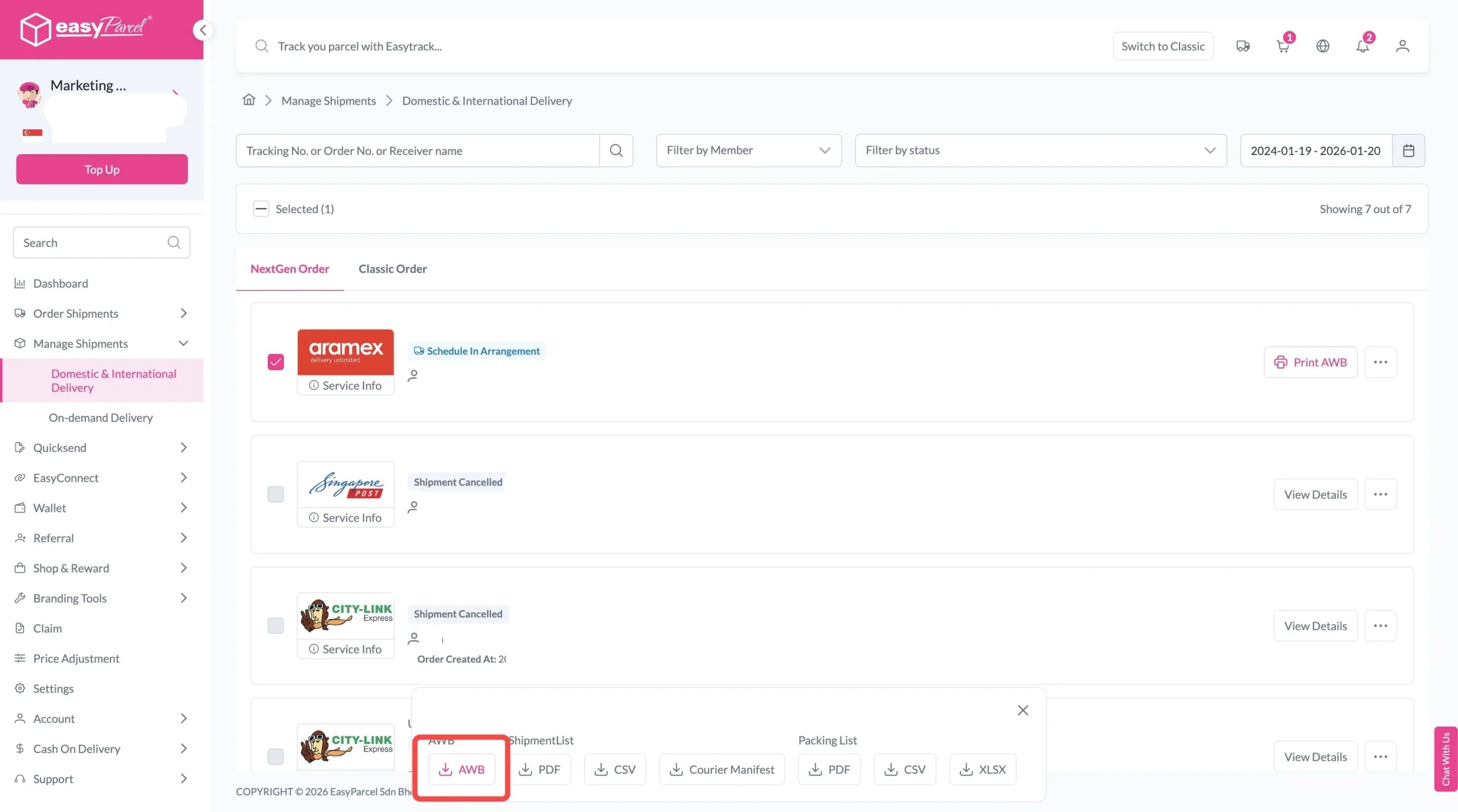
Bulk Downloads AWB
1. Tick the “Selected” checkbox to choose all your orders.
2. A menu will appear at the bottom of the screen.
3. Click “AWB” to download all AWBs in bulk.
Final Thoughts
Using DHL Express Singapore or any other international courier involves more than simply entering an address and paying for delivery.
Checking your parcel measurements, HS Code, customs documents, declared value, destination restrictions and potential duties and taxes before shipping can help you prepare for a smoother international delivery.
And if you’re not committed to DHL, compare your options first.
While DHL Express isn’t available through EasyParcel Singapore, EasyParcel gives you access to alternative international courier services and useful shipping tools, so you can make a more informed choice before your parcel starts its journey.